
The offer Iran put on the table this week is easy to summarise and hard to mistake. Seven days. On the first day, hostilities end on every front, the American naval blockade of Iranian ports lifts, sanctions on Iranian oil are waived, and frozen Iranian assets are released. On the seventh day, the Strait of Hormuz reopens. Talks about Iran's nuclear programme, the issue Washington describes as the war's cause, begin immediately.
Foreign Minister Abbas Araghchi set the sequence out for reporters at the United Nations on Thursday, four days after the plan reached Washington through mediators, and the reaction it produced was quieter than its contents. A White House official described constructive discussions through intermediaries. Another, quoted by The New York Times, said the administration would not rush. Oil barely moved, closing the week at $103.99, roughly where it started it. Seven months into a war that began with American and Israeli strikes, each side is now waiting to see which one the calendar embarrasses first.
What the seven days would contain
The substance, as reported from Araghchi's presentation and the accounts of the mediators' transmission of it earlier in the week, runs in a fixed order because each item depends on the one before it.
Hostilities end first, and on all fronts, which is the demand that makes the plan a regional settlement rather than a bilateral one: the accounts describe the pause applying to Gaza and Lebanon as well as the Gulf. Washington then moves on money and access, releasing frozen Iranian assets that Iranian officials put at no less than $12 billion, waiving the sanctions that price Iranian crude out of legitimate markets, and lifting the naval blockade that has kept the country's oil exports at a fraction of their pre-war volume. Iran moves last, reopening the strait on the seventh day, and the nuclear file opens alongside it.
The sequencing is the argument. Tehran's position since the spring has been that the blockade and the sanctions are acts of war, not leverage to be traded after a ceasefire, so the strait stays shut until they are withdrawn. Washington's position has been the mirror image: the strait reopens first, because a quarter of the world's seaborne oil trade is not a bargaining chip. The seven-day plan does not resolve that dispute. It makes the dispute explicit and puts a number of days on it.
The June memorandum is the real text
The plan's most important feature is not in any of its conditions. It is the document it is modelled on.
The memorandum of understanding signed on 17 June, brokered by Pakistan and Qatar, was the closest the war has come to ending. It gave the two sides a 60-day window, halted strikes, and began staged relief of the oil blockade. It came apart over the question the new proposal still cannot answer: the memorandum's wording on who controlled shipping through the reopened strait was vague enough that each government read it as its own authority, convoys were stopped and searched, attacks resumed, and President Trump declared the deal over on 7 July, six weeks into its two-month life.
Iran's proposal is, on the reporting available, that memorandum restated, with the same brokers involved and the same conditions in the same order, compressed into a week. Iranian officials frame the compression as good faith: if Washington's objection to June was that Iran used the 60 days to consolidate gains, then a seven-day clock removes the excuse. The counter-reading writes itself. A timetable that ambitious was never going to be met by any two bureaucracies, which makes the plan a position paper dressed as an itinerary, designed to fail in a way that locates the failure in Washington.
Both readings can be true at once, and the honest summary is that the plan is a negotiation document whose first purpose is attribution. Iran wants the record to show what it asked for and what the answer was.
What Washington is saying, carefully
The American response has been conducted entirely through anonymity. A White House official told CNN the administration was having positive and constructive discussions through the mediators. An official who spoke to The New York Times said the United States would not rush into a deal. No named official has endorsed the sequence, and none has rejected it.
The caution has a calendar. The midterm elections are in November, and every account of the administration's internal debate this month has described a government that sees no urgency: the strait is partially closed rather than fully shut, oil has stabilised above $100 rather than spiked toward its April peak of $118, and the political cost of a failed negotiation is judged greater than the cost of a slow one. An analyst of the negotiations, Cyrus Schayegh of the Geneva Graduate Institute, put the structural point plainly in remarks to Al Jazeera: Iran keeps insisting that the June memorandum is the basis for any settlement and that it keeps the additional position it gained during the war, the United States keeps refusing that framing, and on his reading no significant movement is likely before the midterms. Araghchi's own comment, that it would be better to reach a deal before the vote, concedes the same calendar from the other side.
President Masoud Pezeshkian spent the week making the complementary case in public. At the General Assembly on Wednesday he said Iran would not bend at the knee, and in a Fox News interview aired Thursday he put the choice entirely on the other capital: Iran does not wish to continue fighting, and it is America that must decide whether it wants to end this, before the elections or after them, it makes no difference to Tehran. Qatar's foreign minister, one of the two brokers of the June memorandum, spoke with Pezeshkian by phone on Friday about de-escalation and the conditions for dialogue, keeping the channel that produced the spring agreement open.
What the oil market did with it
Brent crude closed Friday at $103.99 a barrel, down about 2.5 percent on the session, having spent the week inside a futures range of roughly $99 to $108 on exchange data. The week's net movement was small. The pattern was not.
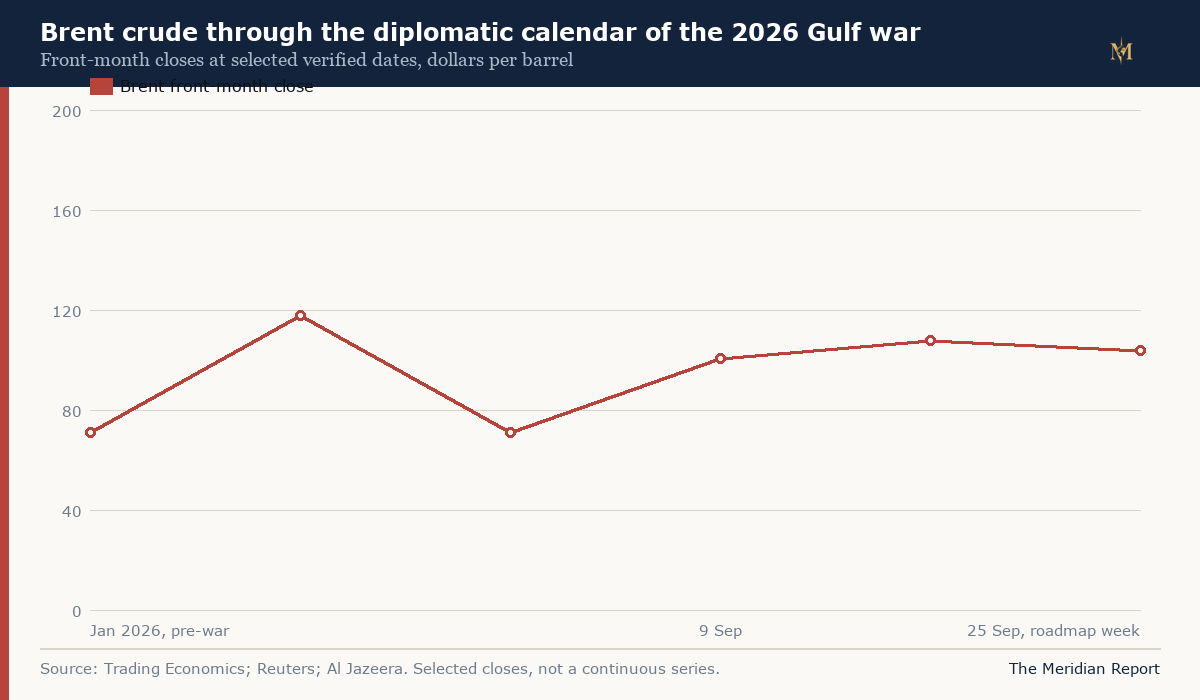
The price has now held above $100 for more than two weeks, roughly 46 percent above its January level near $71, and its behaviour through the diplomatic week rhymes with everything the market taught traders this year. Headlines about proposals move the front of the curve by dollars. Signed agreements and expired ones moved it by tens of dollars. The American government's own forecaster expects Brent to average around $90 in the second half of 2026, a number that presumes the strait's partial reopening and steady supply from the emergency measures that bridged the spring, and the gap between that forecast and the tape is the market's standing judgment that the war premium has further to deflate and no conviction about when.
The round trip earlier this year, from $118 in April back to $71 in June on nothing more than the memorandum's signature, remains the template: this market prices verification, not intention. A seven-day plan with a reopening on day seven is, from the trading floor, a claim about day seven. Friday's close is what a claim is worth before one.
Why Iran moved now
Three pressures converge on Tehran's timing, and they are not mysterious. The war is entering its seventh month, and the condition it produced, a strait that never exceeded roughly 40 percent of normal flows even at its best, has cost Iran its own oil revenue as surely as anyone's. The coalition of mediators that delivered the June memorandum is intact and publicly working; Qatar confirmed the call on Friday. And the American political calendar, which Pezeshkian affected to dismiss, in fact argues for moving now: an agreement reached before November would be the administration's to defend, one reached after it would be negotiated with whoever wins.
Against that, the plan asks Washington to accept June's terms with June's dispute unresolved. The vague wording on shipping control that killed the memorandum appears in no account of the new proposal as having been clarified. Until it is, the seven-day sequence contains the mechanism of its own second collapse, on a schedule seven times faster than the first one.
The week ends where it began, with the plan in Washington's hands and the strait as closed as it was. What would mark real movement is narrow and observable: a named American official engaging the sequence rather than describing discussions, any clarification of the shipping-control language that killed June's deal, and the first convoy data once the strait's partial traffic pattern changes. Until one of those moves, the offer and the reply are both positions, and the oil price is the only referee both sides have agreed to recognise.
Saturday brought the reply, and it was the one the anonymous quotes had promised. The president, speaking to reporters on the White House South Lawn, rejected the plan outright: the deal, he said, would not be acceptable, though he added that Iran wants to make a deal, and I'd like to make a deal, too. Araghchi answered within hours that Tehran had seen an initial reaction but no formal response through the mediators, and that Iran's conditions stand. The full account of the rejection, the Senate vote that fell one vote short two days before it, and the oil market that refused to move, is in the report on the impasse.