
The blockade of Iran has a maritime face that the world watches, the shut strait, the counted tankers, the nine vessels a day, and an aviation face that closed this week with almost no ceremony at all. On Friday, Iraqi state media reported that four airports, Baghdad, Najaf, Erbil and Sulaimaniyah, had suspended every flight to and from Iran. The decisions followed new American sanctions on any company anywhere doing business with Iranian airlines, and they arrived in the same days that the United Arab Emirates halted Iranian service and Qatar restricted it. Iran's civil aviation map is now reduced to a handful of corridors: Türkiye, Russia, China, Armenia.
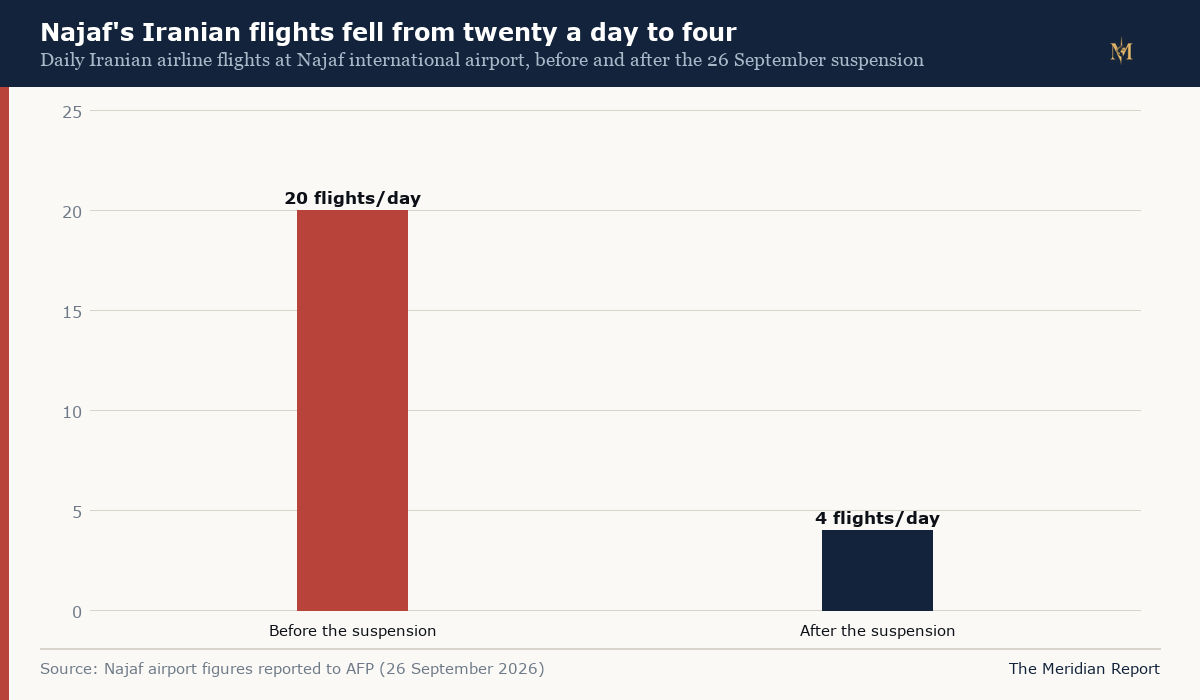
The Iraq suspension is the one that changes daily life. Iraq was the top destination for Iranian carriers, especially after Iraqi Airways stopped flying to Iran when the war began in February, and the traffic is not tourism. It is pilgrimage: Shia families moving between the shrine cities of Iraq and Iran's holy cities, the flow that the Arbaeen season moves by the million. Najaf's airport director, Hussein Muhanna, told AFP the halt came as a directive from the prime minister's office. An Iranian airline employee at the airport put the arithmetic simply: at least twenty daily flights before, four remaining after, all of them to other destinations.
The mechanism, which is a dollar account rather than a law
Nothing in Iraqi or Emirati law grounds Iranian aircraft. The mechanism is downstream of law, in the contracts that keep any airport running. As Al Jazeera's correspondent in Baghdad explained, the companies providing ground services, refuelling, baggage handling, are unwilling to risk secondary sanctions and freezing out of the international dollar system. A ground handling contract is a small thing to lose and an existential thing to be denied: without a refueller, no aircraft lands commercially. The new American measures name the counterparties, and the counterparties are the service companies, so the service companies walk away, and the sanctions do their work without a single aircraft being turned back at the gate.
This is the quietest of Operation Economic Outcast's fronts, and in one respect its most complete. The oil trade has adapted, finding shadows, discounting, moving cargo on a handful of ships; the strait's crude flows have partially recovered even as transits collapsed. Aviation has nowhere equivalent to hide. An airliner needs a foreign airport, and a foreign airport needs dollars, and the two facts together are the whole enforcement case.
The politics inside the compliance
Iraq's government has said nothing publicly, and the silence is the tell. Reporting from Baghdad describes a central government that does not want to antagonise the pro Iranian factions in its own parliament, squeezed between a security relationship with Washington and religious and economic ties to Tehran that no other state in the region shares at the same depth. The directive came from the prime minister's office to a provincial governor, which kept the decision off the cabinet record. Iran's consulate in Najaf posted the question that the suspension raises for the region's Shia public: the shrine of the first Imam and the capital of the last Imam, closed to the largest Shia country in the world?
Iran had threatened exactly this compliance, and worse. The secretary of its Supreme National Security Council warned neighbouring states against imposing the American flight ban in the days before they imposed it, a warning that, like several this month, changed nothing. Iran International's account of the week describes aviation officials now planning around a permanently thinner network, and travellers pushed onto twelve hour land journeys across the Iran Iraq border to make connections the airports no longer carry.
What it means for the war's other clocks
The aviation squeeze lands in the same week as two larger events, the seven day roadmap Iran submitted through Qatar and Donald Trump's rejection of it on Saturday. Read together they show the two pressures Tehran is under moving in opposite directions. Diplomatically, Iran is offering the most concessions it has offered since spring, a ceasefire across the region's fronts, the strait reopened on a timetable, talks on the nuclear file within a week. Economically, the walls are tightening faster than at any point since the war began: flights gone, fuel reserves reported thin, the rial at record lows, inflation near seventy percent by the IMF's estimate.
Which pressure wins is the war's open question. An isolated Iran has less to lose from a long war, and a low cost of saying no; it also has a population absorbing seventy percent inflation, which is not a stable condition for any government. The aviation file is where those forces meet in miniature: it is civilian, it is religious, it is ordinary people at a border, and it is also the enforcement mechanism of a financial siege working exactly as designed. The strait's reopening now has a preface, and the preface is being written airport by airport, in Najaf and Dubai, by companies nobody has ever heard of that hold the fuel contracts.
The week's lesson in one line: sanctions do not need to convince governments, only the companies that serve them.