
The missile war against Saudi Arabia resumed this week at a scale and with a targeting logic that mark it as something more than the harassment the kingdom has absorbed for a decade. Six ballistic missiles intercepted in a single wave on Thursday, aimed not at the capital the Houthis claimed in their own statement but at the two places whose function in this war is strategic: Taif, the western approaches to the Saudi heartland, and Yanbu, the Red Sea terminal through which the kingdom exports its oil when the Persian Gulf is closed to it. The Saudi-led coalition announced the interceptions within hours. The Houthis claimed a sensitive target in Riyadh and Aramco facilities in Yanbu. Neither account is independently verifiable from inside the kingdom, which is itself a measure of how little reporting reaches the strike zones.
The oil market produced the week's most legible commentary. Brent rose about 3 percent on the intercept reports to a one-week high, then gave back much of the move within the session when reports crossed that American and Iranian officials had discussed the strait this week. Two theatres, one price: the market now trades the Gulf war's every front simultaneously, and Thursday's action showed both of them, the Houthi escalation lifting the tape and the diplomacy capping it.
A war measured in chokepoints
The geography explains why this week's wave matters more than its casualty count, which Saudi authorities have not confirmed. The 2026 war has already closed or crippled the Strait of Hormuz, through which the US Energy Information Administration counted 20.9 million barrels per day of oil in the first half of 2025, roughly a quarter of seaborne trade. The kingdom's response to that closure runs through the other corridor: the east-west pipeline to Yanbu, and beyond it the Red Sea and Bab el-Mandeb, the strait between Yemen and Djibouti through which the EIA counted 9.3 million barrels per day of crude and products in 2023, before this war began.
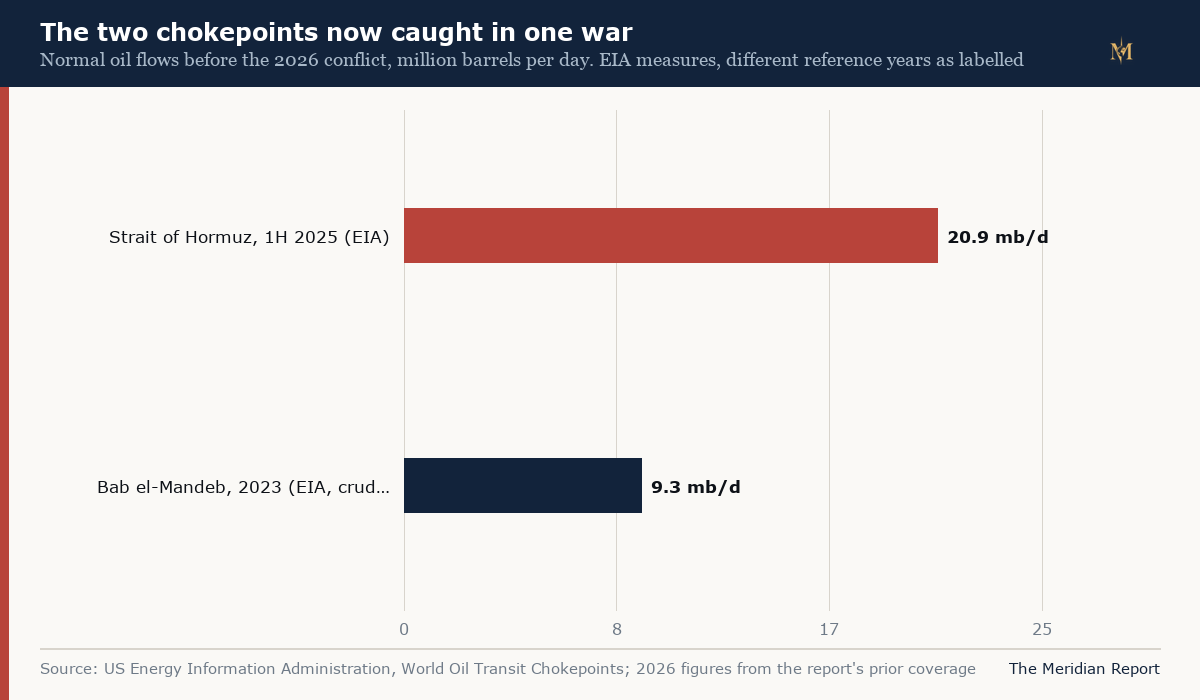
The Houthis spent the summer turning that corridor into a second front. In July they declared a naval blockade on Saudi shipping, a measure they insist applies only to Saudi vessels. In the past two weeks their forces seized the entire Yemeni western coast, arriving at the shore facing Bab el-Mandeb, one of the busiest waterways on Earth. And this month they struck the east-west pipeline itself, the system that was only resuming operations as Thursday's missiles arrived at its terminal. The sequence reads as a campaign: close the Gulf, then close the alternative. A movement armed and directed by Iran, whose own negotiating position improves with every additional barrel the war removes from the market, has put itself astride both corridors at once.
The mathematical distinction the Houthis ask the world to accept, blockade of one flag only, is the week's most consequential claim precisely because it is untestable in advance. Yemen's internationally recognised government, whose vice president addressed the General Assembly on Thursday, made the counter-case in the bluntest available language: navigation safety used as a tool of blackmail is taking hostage the entire global economy, and no economy that depends on secure supply chains should treat the assurance as underwritten. So far, commercial transits continue under elevated war-risk premiums. So far is the operative phrase; the movement's new coastline puts its weapons within sight of the corridor it promises not to close.
The pact activates
Friday brought the development with the widest blast radius. Riyadh's foreign ministry announced that Saudi Arabia, Turkey and Pakistan would hold an urgent meeting of their chiefs of staff to coordinate support against the Houthi attacks under their joint defence agreement, the pact that treats an attack on one as an attack on all three. The announcement is the first reported activation of the trilateral's military machinery in this crisis, and its significance travels in two directions at once.
For Riyadh, outside air defence and surveillance capacity addresses the exact failure mode Thursday exposed: ballistic missiles at the export infrastructure, the one category of attack the kingdom cannot absorb commercially. For Islamabad, whose officials are reported to be deeply worried about entanglement in a war that has already swallowed American, Israeli, Iranian and now Yemeni participants, the meeting is a negotiation over exposure: Pakistan fields one of the largest militaries in the Muslim world and has no interest in spending it on the Red Sea, but it also cannot treat the activation of a defence pact it signed as an optional favour. Ankara's position, between NATO obligations and Gulf energy interests, will decide whether the trilateral becomes an air defence umbrella or a press release.
The ground war underneath
The missile wave rides on a Yemeni ground war that has moved fast while the world watched New York. Two weeks ago the Houthis overran the government's positions along the western coast in a lightning offensive. This week their pressure shifted to the mountain pass of Hejat al-Abd, the lifeline route from Aden to the besieged city of Taiz, where government forces repelled overnight attacks. Taiz's fall would consolidate the movement's hold on everything from Sanaa to the strait, and the government's appeal at the United Nations, for weapons embargoes on the rebels and international protection of navigation, is the request of an administration that knows the next offensive has a shoreline target.
Washington's position in all of it remains the strangest architecture of the autumn: an administration simultaneously mediating with Tehran over the strait, arming Riyadh's air defence by treaty implication, and inviting Iran's regional allies to a Miami summit in December, has no single Yemen policy so much as three contradictory ones running in parallel. The war's second front has produced the year's most underreported escalation, and this week's six missiles at the oil terminal were its clearest signal yet. What would confirm the trajectory: any closure of Bab el-Mandeb to commercial traffic in the transit data, the first trilateral air defence deployments under the pact, and the next Houthi targeting statement that names Aramco infrastructure, which would move the campaign from symbolism to supply war in earnest.