
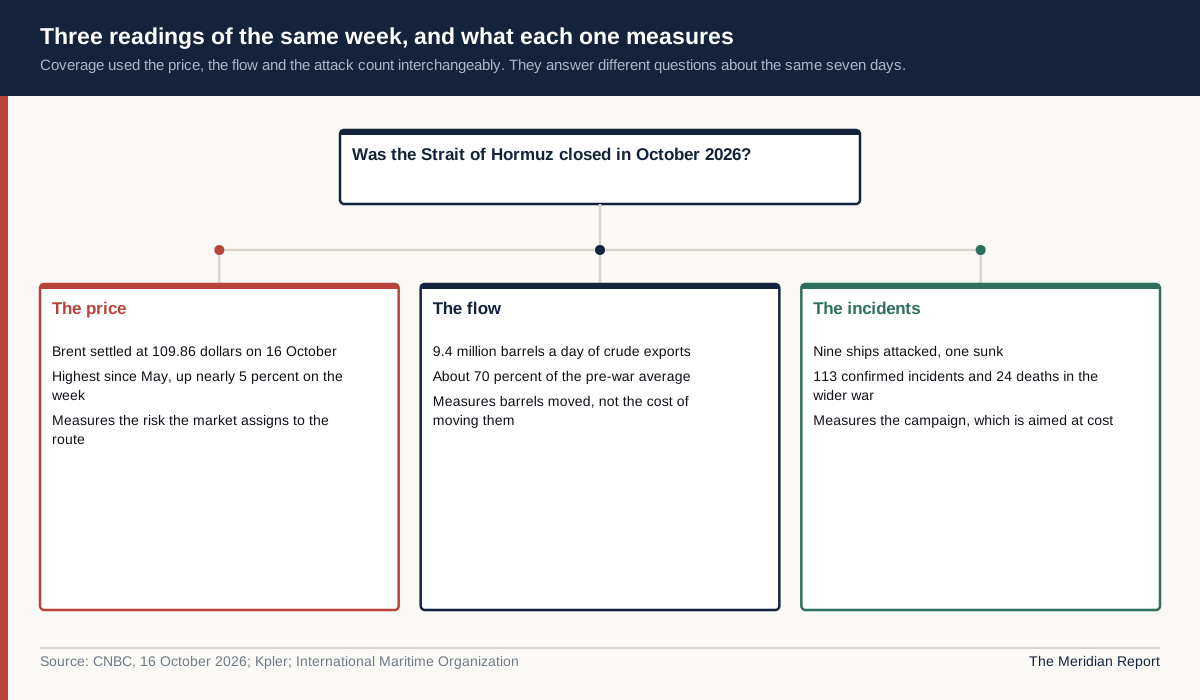
At least nine commercial ships were attacked in or near the Strait of Hormuz in the week to 16 October. One of them, the Singapore-registered container ship GFS Pride, sank. US Central Command attributed the sinking to Iran, and Singapore's maritime authority said the crew had been evacuated safely. The International Maritime Organization recorded six vessels damaged on 11 October and three more on 13 October, one sunk and two damaged, and put the wider conflict's confirmed incident tally at 113 ships and 24 seafarer deaths as of 14 October.
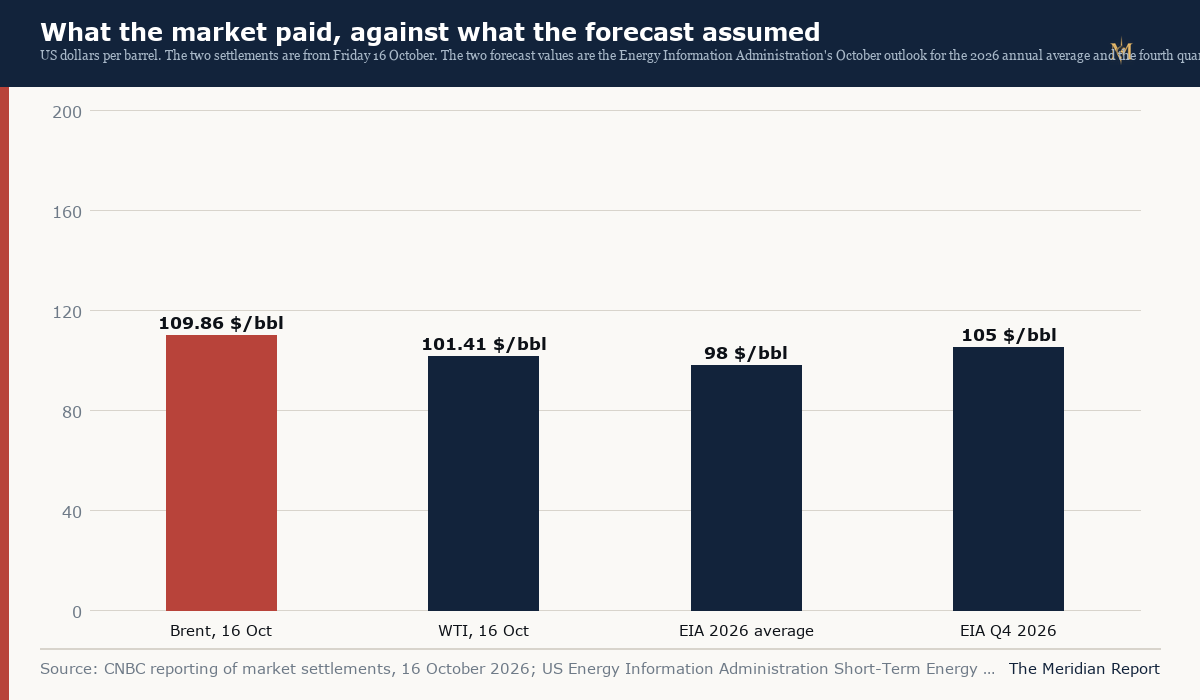
Brent crude settled at 109.86 dollars a barrel on Friday 16 October, up 3.7 percent on the day and nearly 5 percent on the week, after touching 110 dollars in the session for the first time since May. West Texas Intermediate settled at 101.41 dollars and gained more than 10 percent over the same five days. Diesel averaged 6.33 dollars a gallon in the United States, more than 70 percent above the same week last year, according to AAA data cited by CNBC.
The strait did not close. Kpler put crude exports through it at 9.4 million barrels a day for the week ended 14 October, about 70 percent of the pre-war average. That is the number to hold on to, because it separates this week from February, when the war began and the flow collapsed. What changed in October is not the volume of oil trying to move. It is the price of the insurance, the hull, the crew and the certainty that the ship arrives, and those four costs are now the thing Iran is attacking.
What happened between 10 and 17 October
The sequence matters more than the total, because it shows a shift in target selection. On 10 October, Houthi forces attacked Riyadh's international airport, killing 12 people and injuring more than 300, according to the Saudi authorities. On 11 October, the IMO recorded six ships damaged in the strait region: AL MAQAM, DP WORLD KAVERI, KITION M, EVER VICT, ANGOLA PROSPERITY and PETRO DOLPHIN. Three seafarers were injured that day, one on DP WORLD KAVERI and two on EVER VICT, and two were missing from PETRO DOLPHIN.
On 13 October, Saudi Arabia's energy ministry said an Aramco administrative building in Dhahran had been hit. The IMO recorded GFS PRIDE as sunk that day, with GFS GISELLE and AL SAADIYAT damaged. On 14 October, Reuters reported that two commercial vessels had sunk near the strait after projectile strikes, including the Cape Dao, which had been struck on 23 September and went down with one crew member killed. On 16 October, a Saudi military spokesman said several missiles had been intercepted over the Red Sea, including one heading for the Yanbu oil export terminal, and that three drones had been destroyed over Riyadh and the south.
On 17 October, Iran's Revolutionary Guard was reported to have said that a supertanker caught fire after hitting a naval mine in the strait. That claim could not be independently verified by the time this article was published, and it is treated here as a claim rather than an established event.
The IMO's own record carries a discrepancy that no party has reconciled. It lists GFS PRIDE as sunk on 13 October, while CNBC's account of CENTCOM's statement places the sinking on Wednesday 14 October. A one-day gap looks trivial. It is not, because the date determines which of the week's attack waves the sinking belongs to, and therefore whether the escalation preceded or followed the Iranian statement that it was reviewing the US reply.
Why nine attacks matter more than the count suggests
Nine ships is a small number against the volume of traffic. The strait normally carries dozens of transits a day, and a weekly count in the hundreds. Nine attacks among several hundred transits is not a blockade. It is something an insurance market can price, and that is exactly why it works.
The arithmetic a shipowner runs is not the share of ships attacked. It is the probability that the next voyage is the one. Suppose 450 laden transits a week, a conservative figure for a waterway of this size, and nine attacks. The naive weekly probability is 2 percent per transit. A ship making six Hormuz round trips a year would face a cumulative probability of roughly 11 percent of being attacked at least once, if the weekly rate held and if attacks were distributed randomly. They are not randomly distributed: attackers choose hulls, flags and owners, which is why the effective rate for a ship that fits the targeting profile is higher and for a coalition-flagged, well-insured ship can be lower. But the naive calculation is the one that reaches a charterer's desk as a reason to demand a premium, and it is the one that moves the market.
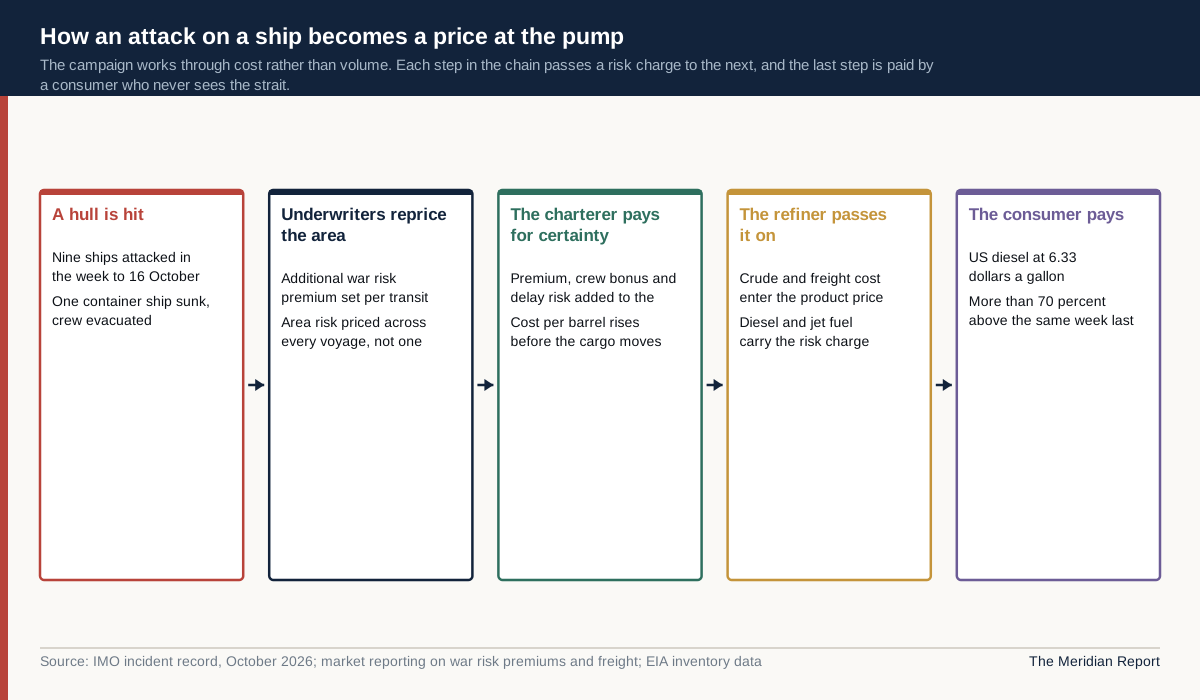
That is the difference between a closure and a campaign. A closure is a supply event: the barrels stop, the price spikes, and the market waits for the strait to reopen. A campaign is a cost event: the barrels keep moving, but each one carries a surcharge for risk, and the surcharge is set by the same attacks that leave the flow intact. Iran does not need to stop 9.4 million barrels a day. It needs to make the next million expensive enough that the buyer, the shipper and the insurer each take a margin, and the sum of those margins becomes a political price.
The week demonstrated the mechanism cleanly. Flows were at 70 percent, prices were at their highest since May, and the negotiation track was alive. All three can be true at once because the attack is aimed at the price of carriage, not the existence of the cargo.
The 70 percent number is doing less work than it appears
The 9.4 million barrel figure is crude exports. It is not total oil liquids through the strait, and it is not products, and it is not LNG. Before the war, the strait carried around 20 million barrels a day of crude, condensate and refined products, according to the US Energy Information Administration's long-running chokepoint work, and a substantial share of the world's LNG. A crude-only series at 70 percent of its own pre-war average can coexist with a much weaker total, because the product and LNG trades have their own routing, their own buyers and their own insurance.
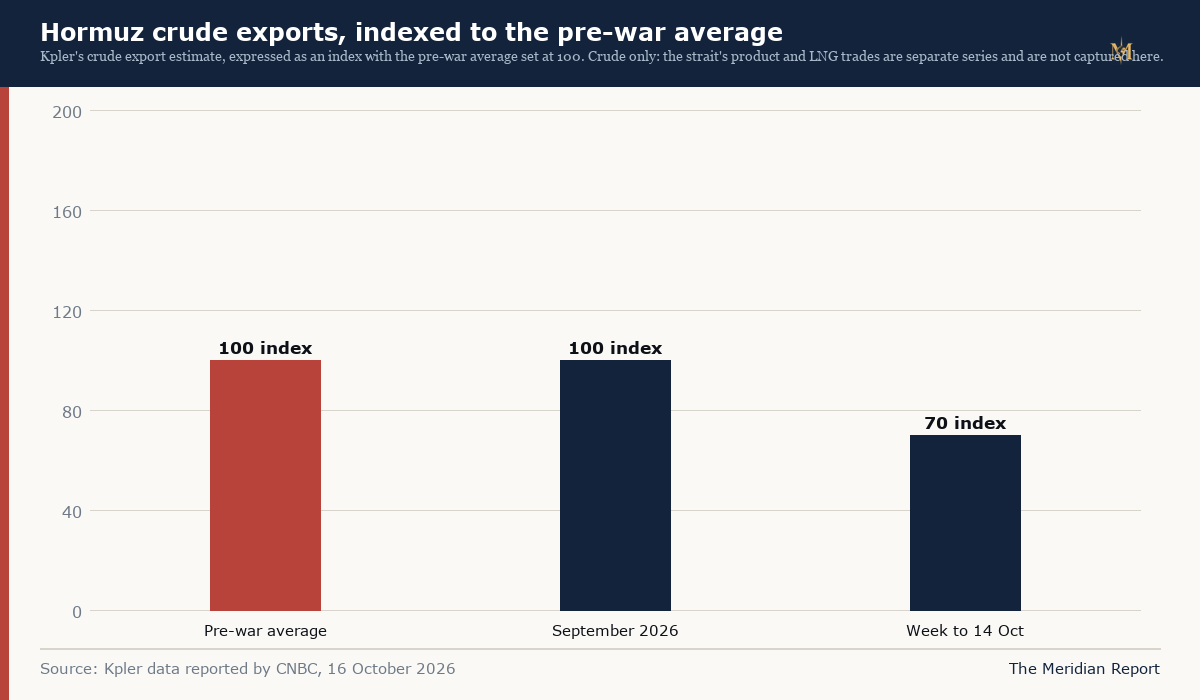
The comparison to February is therefore less reassuring than the headline suggests. In the first months of the war, the IEA reported that flows through the strait had fallen to less than 10 percent of pre-conflict levels. By September, crude exports had touched pre-war levels again, which is what made this week's pullback to 70 percent look like a relapse rather than a continuation. The recovery in between was built on three things: the Saudi East-West pipeline carrying crude to the Red Sea, a partial understanding with Iran about which cargoes could pass, and a shipping market that had learned to price the risk and keep sailing.
Each of those supports is now thinner. The pipeline is a fixed capacity, not a flexible one, and it moves crude rather than products. The partial understanding was the substance of the negotiation that Iran said on 11 October had produced an insufficient US response. And the shipping market's willingness to sail is exactly what nine attacks in a week is designed to test. A flow number can recover before a route recovers, because the flow measures barrels and the route measures the willingness to carry them.
There is a fourth qualification. Kpler's weekly figure is a snapshot of a week, and a week in which ships were being hit is a week in which some cargoes were deferred rather than lost. Deferred barrels return if the risk falls. That makes the number volatile in both directions, and it makes a single week a weak basis for saying the crisis has peaked or that it has bottomed.
What a mine claim changes
The IRGC's reported statement that a supertanker struck a naval mine is, if true, a different kind of event from a projectile strike. A mine is a persistent weapon. It does not require a launcher, a spotter or a decision at the moment of attack. It denies an area rather than a ship, and it turns the water itself into the threat, which changes what insurers, navies and charterers have to do.
A projectile attack can be assessed as a targeted act against a particular hull. A mine threat is assessed as an area risk, and area risk is priced across every transit until the area is cleared. Clearing a mined strait is slow, specialist work. Mine countermeasure vessels, divers and drones have to establish a corridor, and the corridor has to be defended while it is used. The military effort scales with the area, not with the number of ships, and the insurance effort follows the military assessment.
This is why the claim matters even though it is unverified. A single confirmed mine in the main channel would move the question from "which ships are being targeted" to "which lanes are safe", and those are different conversations in every underwriting room in London, Oslo and Singapore. The IMO's incident record does not list a mine strike in the week to 14 October. The claim was made on 17 October and has not been corroborated. The honest position is that the market now has to carry a small probability of a persistent area denial on top of a confirmed campaign of projectile attacks, and small probabilities of large events are what war risk premiums are for.
The insurance arithmetic that decides whether a ship sails
War risk cover for Gulf transits was already the most expensive line in the hull policy before this week. Earlier in 2026, additional war risk premiums on Gulf transits rose from about 0.125 percent of hull value to a reported 7.5 to 10 percent. That is the figure the market carried into October, and it is worth translating into dollars per barrel, because that is the number the cargo pays.
Take a very large crude carrier with a hull value of 120 million dollars and a cargo of 2 million barrels. A premium at 7.5 percent of hull value is 9 million dollars for the voyage. Spread across the cargo, it is 4.50 dollars a barrel. At 10 percent it is 6 dollars a barrel. Add the crew bonus, the convoy cost and the delay risk, and the risk line alone can exceed the freight rate that prevailed before the war. The assumptions are stated because the result is sensitive to them: a newer ship, a smaller cargo or a lower rate produces a smaller number, and an older ship with a cheaper hull produces a smaller absolute premium but a worse loss profile.
That arithmetic explains why the flow has not collapsed. A refiner paying 110 dollars for Brent can absorb 5 dollars of risk cost if the alternative is not running. A trader moving 2 million barrels can absorb it if the destination price is high enough. The cost is real but it is divisible, and divisible costs get passed along the chain until they reach the pump, the airline ticket and the diesel bill. What cannot be passed along is the hull itself. If a ship is lost, the owner takes a capital loss that no freight rate recovers, which is why the decision to sail is made by owners and charterers with different time horizons, and why the market can function at 70 percent while individual owners refuse.
The diesel price is the clearest evidence that the pass-through is working. At 6.33 dollars a gallon, US diesel is more than 70 percent above last year, and that is before the winter heating season and before the northern hemisphere harvest transport peak. Diesel is the fuel that trucking, farming, construction and marine transport run on, and it is the part of the barrel that cannot be substituted quickly. The United States also lost more than 8 million barrels of commercial crude inventories in the week to 9 October, according to the EIA, because Hurricane Isaias shut in Gulf Coast production. A weather event and a war event arrived in the same inventory report, and the market had no way to separate them.
The crew ledger
The IMO's figures are the part of this story that rarely reaches the price column. Twenty four seafarers have been killed in confirmed incidents across the conflict. Three were injured on 11 October and two were missing from PETRO DOLPHIN. Around 20,000 seafarers, port workers and offshore crews have been affected in the region, according to the IMO, and a plan to evacuate around 6,000 seafarers was paused.
A ship is a workplace before it is a cargo. The crew on a container ship in the strait are not in a position to assess the risk, negotiate a bonus or refuse a voyage, and the legal architecture that is supposed to protect them is split between flag states, port states, the shipowner, the charterer and the insurer. War risk cover typically includes a crew war bonus, but the bonus is compensation for risk accepted, not a veto over accepting it. The IMO's evacuation pause makes the point sharply: the institution that records the deaths does not control the movement of the people at risk.
This is also where the campaign's legality is contested. Iran has not published a legal theory for attacking commercial shipping in the strait, and the United States and its partners describe the attacks as unlawful. The IMO's record does not adjudicate. It counts. The counting is doing the work that a legal finding would otherwise do, because a confirmed incident list is what insurers and flag states use when they decide whether a route is safe, and a route that fails that test becomes expensive before it becomes illegal or legal.
Why the talks did not stop the attacks
The negotiation track was active. On 11 October, Iran was reported to have called the US response to its proposal to reopen the strait insufficient. On 12 October, it was reported to be reviewing that response and to reply once the review was complete. Neither statement described a breakdown. Both described a process, and the attacks continued while the process ran.
That pattern is not irrational. A state that is negotiating over the terms of passage has an interest in demonstrating that the alternative to an agreement is costly, and the cheapest way to demonstrate it is to attack shipping without closing the route. Each attack raises the price of the status quo, which is the thing the negotiation is about. If the attacks stopped, the pressure would stop with them, and the offer on the table would look adequate.
The difficulty is that the same logic applies to the other side. The United States has an interest in not appearing to pay for safe passage, because a concession under attack invites more attacks. A negotiation in which both parties are demonstrating resolve by raising the cost of the interim state can continue for a long time without either side walking away. The absence of a ceasefire is therefore not evidence that the talks failed. It is evidence that the talks are being conducted through the shipping market.
The week's diplomatic silence is itself information. No joint statement, no mediator's readout and no announced round were reported between 11 and 17 October. The only public communication was the exchange of positions through the press, which is what parties do when they want the other side's constituents to hear a position without formally tabling it.
The Saudi second front
The attacks on Saudi Arabia are a separate escalation with a separate logic. The Houthi missile and drone campaign against Riyadh, Dhahran and Yanbu is aimed at the kingdom's energy infrastructure and at the credibility of its security guarantee. The 10 October attack on Riyadh's airport killed 12 and injured more than 300. The 13 October strike on an Aramco administrative building in Dhahran was symbolic rather than productive, but symbolism is the point when the target is the assumption that Saudi infrastructure is safe.
The 16 October interception of a missile heading for the Yanbu export terminal is the most consequential event of the week that did not hit. Yanbu is the Red Sea end of the East-West pipeline, the piece of infrastructure that has substituted for the strait since February. A successful strike on Yanbu would not just remove capacity. It would remove the alternative route that has kept the export system functioning, and it would do so at the moment the strait is under attack. The system's redundancy runs through a single pipeline and a single port, and both are now in range.
Saudi Arabia has choices about how to respond, and they are not costless. A direct strike on Houthi launch sites in Yemen risks a wider war and a renewed attack on Saudi cities. A quiet diplomatic channel risks appearing to accept the attacks. The kingdom's own air defence is doing the work in the meantime, and the interceptions are a reminder that the campaign is being fought with a mix of precision strikes and volume, where the volume is designed to exhaust interceptors as much as to hit targets.
The diesel number is a two front war
The 6.33 dollar diesel price is not a Hormuz story on its own. It is the sum of two campaigns that happen to run on the same barrel. Ukraine has spent the year attacking Russian refineries, and Russia has spent the year attacking Ukraine's power system. The energy ceasefire that President Donald Trump tried to broker in October unraveled within days: the Kremlin kept striking Ukrainian infrastructure, and President Volodymyr Zelenskyy said Kyiv would resume strikes on Russian refineries in retaliation. Every refinery taken offline removes product from the same Atlantic and Mediterranean markets that the Gulf is trying to supply.
That is why the two conflicts cannot be priced separately. A barrel of crude is not a barrel of diesel. The refinery is the conversion step, and the conversion step is fixed in the short run: a refinery that is damaged cannot be replaced by a cargo of crude, and a cargo of crude that cannot be refined into middle distillates does not solve a diesel shortage. The Gulf campaign removes product from the export side. The Russian campaign removes refining capacity from the supply side. The two effects meet in the same inventory report and the same pump price.
The interaction is visible in the way the market treated the week's news. Brent rose 3.7 percent on Friday, but the larger weekly move was in WTI, which gained more than 10 percent. WTI is the more domestic of the two benchmarks, and its outperformance is what a market looks like when the fear is about physical availability rather than the value of a global marker. The EIA's report of an 8 million barrel commercial crude draw, caused by Hurricane Isaias shutting in Gulf Coast production, added a third shock in the same week. Weather, war and refining all reduced supply at once, and none of them is reversible on a political timetable.
This is the part of the analysis that a single commodity price hides. The world has spent the year substituting around the Gulf, rerouting cargoes, releasing reserves and buying barrels from further away. Those substitutions work on crude. They do not work on the product slate, because the product slate is determined by the refineries that are still running and by the tankers that can reach them. A diesel market at 70 percent above last year is telling you that the substitution has reached its limit, not that it has succeeded.
What would count as de-escalation
The metrics that matter are not the ones that make headlines. A decline in the number of attacks is necessary but not sufficient, because attacks can pause for a negotiation and resume after it. The first real indicator is the war risk premium. If underwriters begin to reduce additional premiums on Gulf transits, they are making a judgement about the probability of loss over the next several months, and that judgement is based on evidence they pay for. A premium that stays at 7.5 to 10 percent while the attacks stop is a market saying the pause is tactical.
The second is the composition of the flow. A return to 70 percent in crude while products and LNG remain depressed is not a recovery of the route, it is a recovery of one cargo type. The strait's value is as a combined corridor, and the product trade is the part that feeds diesel, jet fuel and heating oil. A crude-only recovery can coexist with a product crisis, and the diesel price is the tell.
The third is the insurance of the alternative. If the Red Sea and the Bab al-Mandab become the expensive route, the system has no cheap way around the Gulf, and the risk premium becomes a permanent tax rather than a temporary one. The Houthi capture of Yemen's Red Sea coast in September, documented in this publication's reporting on the chokepoint economy, means the alternative is now controlled by the same network that is attacking Saudi Arabia. A route is only an alternative if it is safer than the route it replaces.
The fourth is the negotiation's form. A public round with a named mediator, a written agenda and a defined sequence would be a change in kind. The exchange of statements through the press is a change in temperature. The market will price the first and ignore the second, which is why the next few weeks of diplomatic choreography matter more than the next few days of attack counts.
What the record does not establish
The record does not establish that Iran ordered every attack in the week. The GFS Pride sinking was attributed to Iran by CENTCOM. The mine claim was made by the IRGC. The other incidents are attributed to projectiles, drones or unidentified actors, and the IMO's list records the event without assigning responsibility. A campaign can be directed, tolerated or exploited by a state, and the difference matters for whether a negotiation can stop it.
The record does not establish the exact number of ships hit. CNBC reported at least nine since Sunday. The IMO recorded nine vessels across 11 and 13 October, one sunk and eight damaged, which is consistent with the CNBC count but not identical to it. The Cape Dao, struck on 23 September, sank later and is part of the same campaign but not the same week. Counting rules differ, and a count is not an audit.
The record does not establish that the strait is mined. It establishes that a party claimed a mine strike. The distinction is the difference between an area denial problem and a targeting problem, and it determines whether the response is mine countermeasures or convoy escort.
The record does not establish where the oil price goes next. The EIA's October outlook put Brent at an average of about 98 dollars for 2026 and 105 dollars in the fourth quarter, with production shut-ins averaging 4.5 million barrels a day in the quarter. The Friday settlement of 109.86 is above both, which means the market is already pricing more risk than the official forecast. A forecast is a baseline, not a ceiling, and the EIA has revised its oil price forecast upward repeatedly this year.
What the week established
The week established that the campaign has entered a phase in which the flow can continue while the route deteriorates. Nine attacks, one sinking and a 70 percent flow are not contradictory. They are the signature of a strategy that targets the cost of carriage rather than the volume of cargo, and it is working because the cost of carriage is where the political pressure is.
It established that the negotiation and the attacks are not alternatives. They are being conducted together, by the same state, for the same purpose. A reader who waits for the attacks to stop before believing the talks are serious will wait through several more rounds of both.
It established that the system's redundancy is thinner than the flow numbers suggest. The Saudi pipeline and the Red Sea port are carrying the load that the strait cannot, and both are now targets. The Bab al-Mandab alternative is controlled by the Houthis. The Cape route adds thousands of miles and weeks of transit. There is no fourth route that can absorb a failure of the first three at short notice.
And it established that the price of the war is being paid in places that do not appear in the attack count. It is paid at the diesel pump in the United States, in the insurance premium on a hull in Singapore, in the wage bonus of a crew that cannot refuse the voyage, and in the inventory draw that a hurricane and a war produced in the same week. The strait is still open. The question the market is pricing is how much longer it can stay open at a price the world can afford.