
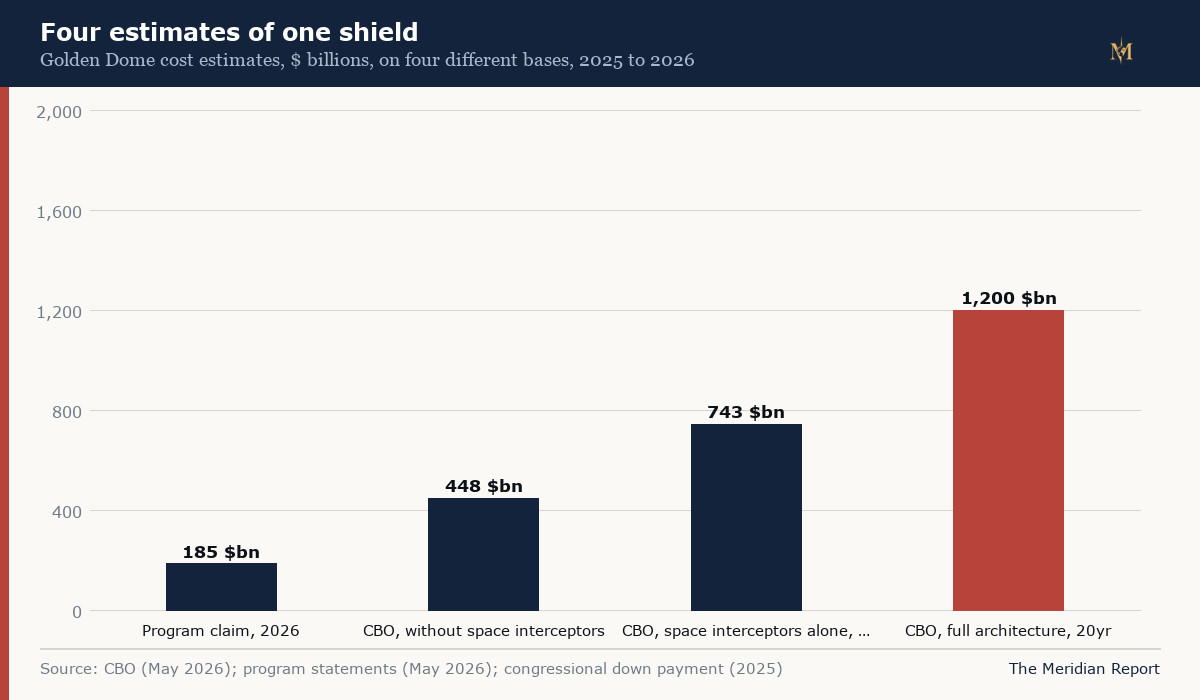
No other weapon programme carries a number as loud as this one. Golden Dome, the homeland missile shield ordered by executive action in January 2025, has been priced at $175 billion by its sponsor, $185 billion by its programme office, $448 billion by the Congressional Budget Office in a version without space-based interceptors, and $1.2 trillion with them. Each figure answers a different question, and the gap between the cheapest and the most expensive is the size of a decade of the entire defence budget. The programme's own problem is that the version of the shield that independent physicists doubt can work at all is the version that sits in the middle of the cost range, the space-based interceptor layer, which by every published review needs a thousand or more orbiting weapons and still fails against solid-fuel missiles that burn out of their boost phase before an interceptor can reach them.
This explainer separates what Golden Dome consists of, what has actually been ordered and built, and what the physics and the test record say it can and cannot intercept.
The order: what the executive mandate actually says
Executive Order 14186, signed 27 January 2025 and titled The Iron Dome for America, is not a hopeful press release. It is a binding directive to the Secretary of Defense to submit, within 60 days, a reference architecture and implementation plan that includes, at minimum, eight elements:
- Defence against ballistic, hypersonic, advanced cruise missiles and other next-generation aerial attacks from peer, near-peer and rogue adversaries;
- Acceleration of the Hypersonic and Ballistic Tracking Space Sensor layer;
- Development and deployment of proliferated space-based interceptors capable of boost-phase intercept;
- Deployment of underlayer and terminal-phase intercept capabilities postured to defeat a countervalue attack;
- Development and deployment of a custody layer of the Proliferated Warfighter Space Architecture;
- Capabilities to defeat missile attacks prior to launch and in the boost phase;
- A secure supply chain for all components, with next-generation security and resilience features;
- Non-kinetic capabilities to augment the kinetic defeat of the same threats.
The same order rewrites policy. Since 2002, when the United States withdrew from the Anti-Ballistic Missile Treaty, official homeland missile defence policy had been to stay ahead of rogue-nation threats and accidental or unauthorized launches. EO 14186 replaces that with defence against any foreign aerial attack on the homeland, and, in a clause that drew less comment than the shield itself, a guarantee of the nation's secure second-strike capability. A December 2025 follow-on order, EO 14369 on American space superiority, extended the same framework into the wider space domain.
The order's own arithmetic exposes its ambition. The countervalue attack it demands defences against, a strike on cities, is by definition a nuclear strike from a nuclear-armed peer, and no deployed or proposed American interceptor system has demonstrated the ability to defeat that. The executive mandate requires a shield that would change the strategic balance, and the physics reviews say the space layer at its core does not yet exist.
What already exists: the fleet Golden Dome inherits
The systems listed in this section are real, deployed and have intercepted targets. None of them was built for the peer threat the executive order describes.
The oldest layer is the Ground-based Midcourse Defense system. Forty four ground-based interceptors sit in silos at Fort Greely, Alaska, with four more at Vandenberg Space Force Base, California, designed to destroy intermediate-range and intercontinental ballistic missiles in the midcourse of flight, outside the atmosphere, by physically colliding with them. Its test record is a real but narrow achievement. Across GMD's hit-to-kill intercept tests, roughly 57 percent have succeeded, and the successful tests share a pattern: the target is a mocked-up rogue-state missile, the defenders know the launch window, and the target carries few or none of the countermeasures a peer arsenal would deploy, the decoys, the chaff, the tumbling debris, the cooled reentry vehicles that midcourse sensors struggle to distinguish. The programme has proven it can hit a warhead with another projectile at closing speeds above seven kilometres per second when the conditions cooperate. It has not proven it can do so under attack conditions, and the Congressional Budget Office's own summary of the comparable architecture notes the system would not be an impenetrable shield.
Aegis and SM-3 are the sea-based tier. The Navy's Aegis Ballistic Missile Defense system, with SM-3 interceptors, has the most successful test record of any American missile defence, and demonstrated an intercontinental-class intercept in a 2020 test when an SM-3 Block IIA destroyed an ICBM-representative target. It is a regional system on ships, and its geometry suits theatre defence, not a homeland shield.
At the last line before impact sit the terminal defences. THAAD and Patriot batteries defend point targets and terminal phases of flight, and have strong records against shorter-range ballistic and cruise threats in combat conditions. They are the underlayer, the last line before impact, not the shield.
None of the layers works without the sensors, the early warning radars and satellites that feed all of the above, from the upgraded early warning radar at Pituffik to the Space Based Infrared System, detect launches and track threats. They are the reason any intercept is possible at all, and they are the part of the stack the Greenland agreement formally ties into Golden Dome.
What has been ordered: contracts, prototypes and money
Golden Dome's own additions to that fleet are, as of this week, a ledger of contracts rather than a fielded capability.
The first is money. The 2025 reconciliation act, the One Big Beautiful Bill Act, appropriated roughly $25 billion as a down payment, against the programme's $175 billion early estimate. The programme office, led by General Michael Guetlein, has since settled on a $185 billion figure, including about $10 billion for space sensors not originally in the plan. The CBO's May 2026 report analysed a notional architecture assembled from the executive order's stated objectives and put the 20 year cost at $1.2 trillion, with the space-based interceptor constellation alone at $743 billion. Guetlein publicly dismissed that estimate, arguing for commercial pricing and a smaller architecture. The gap between the numbers is not a rounding error. It is the difference between a procurement and a strategic commitment.
The second is procurement. The Missile Defense Agency's SHIELD contract vehicle, awarded at the end of 2025, is a $151 billion multiple-award IDIQ with roughly 2,440 prime awardees, a marketplace rather than a weapon. Space Force has awarded up to $3.2 billion across 20 contracts to 12 companies for Golden Dome interceptor prototypes, including awards to Northrop Grumman, Anduril, Lockheed Martin and True Anomaly for boost-phase space-based interceptor development. The Space Development Agency awarded $1.75 billion in July 2026 to L3Harris and Sierra Space for 36 Tranche 3 missile-tracking satellites, the custody and tracking layer the executive order requires. Prototype schedules target initial demonstrations around 2028.
The third is architecture, still unresolved. No decision is public on the size of any interceptor constellation, on whether the space-based interceptors will be kinetic or directed energy, on launch vehicles or on cost caps. The programme's own leadership has acknowledged the scope and secrecy have made outside cost estimates difficult. What is public is the direction: a shield built from a larger, proliferated, resilient set of smaller satellites and interceptors, rather than a small number of exquisite platforms.
What it can intercept, and what it cannot
The honest answer is a split verdict, by phase of flight.
The first minutes of flight, the boost phase, are where Golden Dome's distinctive bet lives, and where the physics is least forgiving. A missile's boost phase for a liquid-fuel ICBM lasts roughly three to five minutes, and for a solid-fuel one, as little as two. An interceptor must be based close enough to reach the ascending missile in that window, and an interceptor in orbit, moving at orbital velocity, sweeps over any given point of the Earth in minutes. The American Physical Society's 2025 review concluded that defeating even a single liquid-fuel ICBM from North Korea in boost phase would require roughly 400 orbiting interceptors, and that a solid-fuel ICBM would need around 1,600, because the missile burns out too quickly for any orbital geometry to reach it. CBO's updated models put the range at 1,000 to 2,000 interceptors, at satellite masses of 600 to 3,000 kilograms, with 20 year costs of $161 billion to $542 billion in 2025 dollars. The Bulletin of the Atomic Scientists, writing in September 2026, examined the proposal's 40 to 80 kilogram interceptor satellites and concluded the mass budget does not close: an interceptor light enough to deploy in the required numbers cannot carry the propellant to reach its target. The verdict of every published physics review is the same: as a defence against a peer arsenal, a boost-phase space layer does not yet exist on paper, and its cost balloons with each additional threat scenario it must cover.
The long coast of midcourse flight is where the existing fleet does its work, and where the record is genuinely mixed. GMD's 44 interceptors have a real test record against limited, unwarned, unsophisticated threats. Against a peer attack, midcourse defence faces decoys, chaff, cooled reentry vehicles and submunitions that turn the problem from interception into discrimination, and the system's own test record does not demonstrate a solution. The Aegis/SM-3 system has the better record and the demonstrated ICBM-class intercept, and its vessels patrol the oceans that most threat trajectories overfly. The midcourse layer can plausibly handle a small, unsophisticated attack. It cannot plausibly handle a salvo from a peer arsenal, and no published test has attempted one.
Terminal phase. THAAD and Patriot have real combat intercepts and high single-engagement probabilities against shorter-range threats. Against ICBMs, terminal defence is a geography problem: the interceptor must be based where the warhead will arrive, the warhead arrives at seven kilometres per second, and the defended footprint of a terminal system is small. A terminal layer can protect a military base or a city's key infrastructure. It cannot be scaled to defend the continent, which is why the executive order's countervalue attack language requires the boost and midcourse layers to work first.
Prior to launch. The executive order's left-of-launch element, defeating missiles before they fly, is a real capability of American offensive forces, and it is why a first strike against the United States remains unattractive regardless of how Golden Dome performs. It is also not a shield. It depends on warning, surveillance and the willingness to strike first, and it fails exactly when a defence shield is supposed to succeed: against a surprise attack.
The Greenland connection
The Greenland defence agreement signed on 22 September 2026 names a Golden Dome defence system among the purposes of the bilateral arrangements in its preamble, formally connecting Pituffik's radar geography to the homeland shield for the first time in a treaty text. The base's upgraded early warning radar watches the polar corridor that a missile from Asia to North America would cross, and the agreement's own text obliges the two sides to exchange information on missile threats. The treaty does not station Golden Dome hardware in Greenland; it binds the ground segment, the sensors that see the attack coming, into the architecture that the shield's interceptors, wherever they are eventually based, would depend on.
The verdict the record supports
Golden Dome consists of a binding executive mandate, a $25 billion down payment, a $185 billion programme estimate against a $1.2 trillion CBO estimate for the comparable architecture, prototype contracts across at least 12 companies, and an inherited fleet whose systems have genuinely intercepted targets but never under peer attack conditions. The layered shield's midcourse and terminal elements have demonstrated capability against the threat the policy of 2002 to 2025 described, a limited rogue attack. The boost-phase space layer that distinguishes Golden Dome from that inheritance has been awarded prototype contracts and has not flown. Every independent physics review concludes it cannot be built at the scale the mandate describes without a constellation of a thousand or more interceptors and a cost that would exceed the entire defence budget for years, and even then it would fail against solid-fuel missiles whose boost phase is too short for any orbital interceptor to reach.
What the programme can deliver, on the evidence: better sensors, a larger tracking constellation, faster kill chains, and deeper inventories of interceptors for the limited-attack scenarios the existing fleet was built for. What no published evidence supports: a dome. The record's honest summary is that the United States is buying a thicker set of layers against limited attacks while writing physics cheques the boost phase of a solid-fuel missile will not honour.
FAQ
What is the Golden Dome missile defence programme?
A next-generation homeland missile defence initiative established by Executive Order 14186 in January 2025. It directs a layered shield against ballistic, hypersonic and advanced cruise missiles, combining accelerated space sensors, space-based interceptors, terminal defences and non-kinetic capabilities with systems the United States already flies. The Pentagon has cited a $185 billion programme estimate; the Congressional Budget Office's May 2026 analysis of a comparable architecture put the 20 year cost at $1.2 trillion.
Can Golden Dome stop an ICBM?
Partially, in narrow cases, and nothing resembling completely. The existing Ground-based Midcourse Defense system has intercepted crude, unwarned test targets resembling limited rogue-state threats, with roughly a 57 percent historical hit-to-kill success rate and recurring doubts about its performance against realistic countermeasures. No space-based interceptor exists. Every independent physics review concludes that a boost-phase shield against a peer arsenal would require a thousand or more orbiting interceptors and would still fail against solid-fuel missiles that burn too briefly.
Has Golden Dome intercepted anything yet?
No. The programme has awarded prototype development contracts for space-based interceptors and satellite production contracts for tracking constellations, but no Golden Dome interceptor has flown, let alone intercepted a target. The only demonstrated exoatmospheric intercept capability remains the pre-existing Ground-based Midcourse Defense and Aegis systems, whose tests do not involve a peer adversary's countermeasures.
Why does Greenland appear in this programme?
The Greenland defence agreement signed in September 2026 names a Golden Dome defence system among the purposes of the bilateral arrangements in its preamble, formally connecting Pituffik's radar geography to the architecture. The base's upgraded early warning radar watches the polar corridor that a missile from Asia to North America would cross, and the agreement's own text obliges the two sides to exchange information on missile threats. Construction that expands the base serves the sensor mission that any homeland defence layer depends on.