
An export control licence application is a document that asks a government to allow a company to sell something to someone. It identifies the item, the destination, the end user and the end use, and it is reviewed by an official who has to decide whether the sale is consistent with the national security and foreign policy of the United States. The form is routine. The decision is not.
The American export control system is the most extensive in the world, and it regulates not only American companies but foreign companies that use American technology, American software or American equipment. A Taiwanese foundry that makes chips with American design tools and American machines is subject to American rules when it sells those chips to a Chinese customer. A Dutch company that makes lithography machines with American components is subject to American rules when it exports them. That reach is the reason the controls matter, and it is the reason they are contested.
The system is best understood as a licensing regime rather than a wall. A wall stops a transaction. A licensing regime allows some transactions, delays others and refuses a few, and its effect depends on how the refusals are distributed. The advanced semiconductor controls are designed to refuse the transactions that would give China the ability to make the most advanced chips, and to allow the transactions that would not. Drawing that line requires a technical judgment about what a chip can do, an intelligence judgment about what a customer will do with it, and a diplomatic judgment about what an ally will accept.
Five years of those judgments have changed the semiconductor industry. They have not produced the outcome that the controls were designed to produce, and they have produced several that were not intended. The record is a case study in the limits of economic statecraft when the target is a technology rather than a country.
The architecture in one page
The American system has two centres. The Bureau of Industry and Security administers the Export Administration Regulations, which cover dual use items: goods and technology that have a commercial use and a military application. The Office of Foreign Assets Control administers sanctions, which cover dealings with people, entities and countries. The two are separate, they have different legal authorities and they produce different obligations, and a company that complies with one may still be in breach of the other.
The Export Administration Regulations are organised around a classification. Every item is assigned an export control classification number, or ECCN, and the number determines the controls that apply. An item that is not listed is designated EAR99, which means it is subject to the regulations but not to a specific control. The classification is the foundation of the system: a company that misclassifies its product can export without a licence an item that required one, and the penalty is calculated per violation.
The regulations then apply a destination based control. Each country has a country group, and the group determines the licence requirements for a given classification. The most restricted destinations are subject to a policy of denial for most items. The closest allies are subject to few controls. The middle is where most of the trade happens, and it is where the licensing decisions are made.
The third element is the end user. A party on the entity list is subject to a licence requirement for all items subject to the regulations, and the review is conducted with a presumption of denial. The list is supplemented by the denied persons list, the unverified list and the military end user list, each with a different consequence. The end user controls are what turn a destination based system into a targeted one.
The fourth element is the re-export control. A foreign made item that contains more than a threshold share of American controlled content, or that is the direct product of American technology, is subject to the regulations when it is re-exported. That is the mechanism that gives the system its global reach, and it is the mechanism that allies resent most.
How an item is classified
The classification is a technical exercise with legal consequences. An ECCN is assigned by the manufacturer, in the first instance, by comparing the product's specifications to the control list. The list is written in parameters: a microprocessor with a certain performance, an analogue to digital converter with a certain resolution, a lithography machine with a certain overlay accuracy. A product that exceeds the parameter is controlled; a product that does not is not.
The parameters are revised, which means a classification is not permanent. The October 2022 controls on advanced computing introduced new performance thresholds for chips, and the 2023 and 2024 updates revised them. A chip that was not controlled in 2021 became controlled in 2022, and a company that had built its business on exporting it had to change its product line or apply for a licence.
The revision is a deliberate instrument of policy. A threshold can be set just above the performance of the chips that China can make, which squeezes the supply of the next generation without banning the current one. The difficulty is that performance is continuous, and a chip that is just below the threshold can be used in a system that is just above it. The controls try to capture the system as well as the chip, and the system is harder to define.
The classification can be requested from the Bureau of Industry and Security in a commodity classification request, which produces a formal determination. The requests take months, and companies often self-classify and accept the risk. The risk is asymmetric: a company that over-classifies loses sales, and a company that under-classifies faces penalties and the possibility of a criminal referral.
The entity list and the problem of ownership
The entity list is the most visible instrument in the system, and it is the one that companies fear most. A listing imposes a licence requirement on exports to the listed party, and the review is conducted with a presumption of denial. In practice, a listing severs the party from American technology, and a company that depends on American chips, software or equipment cannot continue to operate at the same scale.
The list has grown from a few dozen entries to thousands, and it covers universities, research institutes, companies, individuals and government bodies. The additions are made by the End User Review Committee, which includes representatives of the departments of Commerce, State, Defense, Energy and the Treasury, and the criteria include national security, foreign policy and human rights.
The weakness of the list is ownership. A listed company can create a subsidiary, a joint venture or a shell company that is not listed, and the subsidiary can buy the item that the parent cannot. The American response, announced in September 2025, was to extend the restrictions to any entity owned at 50 per cent or more by one or more listed parties, a rule modelled on the OFAC 50 per cent approach. The extension closes the subsidiary loophole and it creates a new compliance burden, because a company now has to trace ownership through layers of corporate structure that are not always public.
The removal process is slow. A listed party can petition for removal, and the petition is reviewed by the same committee that added it. The review can take years, and the party has no right to see the evidence against it. The result is that a listing is close to permanent, and companies that are listed build a business that does not depend on American technology. EOF python3 - <<'PY' s=open('src/content/articles/export-controls-architecture-report-2026.md').read() print('body words', len(s.split('---',2)[2].split())) PY
The foreign direct product rule is the heart of the system
The rule that gives the American controls their reach is the foreign direct product rule, and it was not designed for semiconductors. It was designed to prevent a controlled item from being shipped to a country through a foreign factory that used American technology, and it has been used, expanded and contested for more than thirty years.
The rule works by treating a foreign made item as subject to American controls if it is the direct product of American technology or software, or if it is produced by a plant or a major component of a plant that is itself the direct product of American technology or software. The scope of the rule depends on the definition of direct product, which the Bureau of Industry and Security has expanded several times, and on the list of destinations and end users to which it applies.
The Huawei designation in 2020 was the moment the rule became a semiconductor instrument. The Bureau applied the rule to foreign made chips that were produced using American software or equipment and that were destined for Huawei, which meant that a Taiwanese foundry could not make chips for Huawei even if the chips contained no American components. The rule was extended and refined, and it became the template for the advanced computing controls of 2022.
The 2022 controls went further. They restricted the export of advanced computing chips, the equipment used to make them, and the American technology and personnel used to develop them, and they applied the restrictions to American persons as well as American companies. The controls were designed to slow China's access to the most advanced logic, the most advanced memory and the tools that make both, and they were accompanied by a new set of end use controls on supercomputers and artificial intelligence.
The 2023 and 2024 updates tightened the thresholds, added new categories of equipment, and closed routes that the earlier rules had left open. The December 2024 update added high bandwidth memory to the controlled list, because memory is as important as logic for artificial intelligence, and it extended the controls to more Chinese companies.
The AI diffusion rule and its retreat
The most ambitious attempt to turn the controls into a global architecture was the AI diffusion rule, issued in January 2025. The rule created a three tier system for the export of advanced artificial intelligence chips and the models trained on them. The first tier was a small group of allies, which could buy without a licence. The second tier was a large group of countries, which could buy within a quota. The third tier was the adversaries, which could not buy at all.
The rule was a departure from the case by case approach. It tried to manage the global diffusion of computing capacity rather than the export of individual chips, and it required the American government to make judgments about the computing needs of dozens of countries. It was also a departure in its treatment of models: it proposed controls on the weights of advanced artificial intelligence models, which are not goods in the ordinary sense and which can be transmitted over the internet.
The rule was rescinded in May 2025, four months after it was issued. The reasons were a combination of industry opposition, allied objection and a change of approach in the administration. The replacement has been a set of bilateral arrangements with allies and a case by case licensing policy, which is less coherent and less predictable.
The episode is instructive for two reasons. The first is that a rule that tries to manage a global technology requires a global administrative capacity that the United States does not have. The second is that the allies who were placed in the second tier objected to being treated as a category rather than as partners, and their objection was decisive. A controls regime that depends on allied cooperation cannot afford to alienate the allies.
The allies are the weak point and the strength
The advanced semiconductor supply chain is not American. It is Dutch, Japanese, Taiwanese, Korean and American, and the controls work only if the other countries apply equivalent restrictions.
The Netherlands is the home of ASML, the only company that makes extreme ultraviolet lithography machines, and the only company that makes the most advanced deep ultraviolet machines. ASML's machines are the gate through which every leading edge chip must pass. The Dutch government introduced export restrictions on advanced semiconductor manufacturing equipment in 2023, and it has licensed the export of some machines to China while refusing others. The restrictions are aligned with the American controls and they are not identical, and the difference is a source of friction.
Japan is the home of Tokyo Electron, which makes deposition, etch and cleaning equipment, and of Shin-Etsu and Sumco, which make silicon wafers. The Japanese government added twenty three categories of semiconductor manufacturing equipment to its export control list in 2023, and it has required licences for exports to China. The Japanese rules are formally neutral and they have a similar effect, which is the diplomatic formula that allows an ally to align without saying so.
Taiwan is the home of TSMC, the largest and most advanced foundry. TSMC is subject to American controls because it uses American equipment and software, and it has stopped shipping advanced chips to Chinese customers. The Taiwanese government has its own rules, and the combination of American pressure and Taiwanese interest has produced a de facto restriction that is not written as one.
South Korea is the home of Samsung and SK Hynix, which make memory and logic, and of companies that supply the equipment and materials. The Korean government has been more cautious than the Dutch or the Japanese, because its companies have large investments in China and because it does not want to lose the market. The American pressure on Korea has been persistent and the alignment is partial.
The result is a regime that is strong where the allies are aligned and weak where they are not. A machine that is not restricted in the Netherlands can be sold to China, and a chip that is not restricted in Korea can be sold to a Chinese customer. The American response has been to use the foreign direct product rule to reach the foreign transactions, and to negotiate with the allies to close the gaps. The negotiation is continuous, and it is the real location of the policy.
The alliance cost of the controls
The controls impose costs on the allies as well as on China, and the costs are political.
ASML's sales to China were a significant share of its revenue, and the restrictions reduced them. Tokyo Electron and the Japanese equipment makers lost business. Samsung and SK Hynix had to restructure their Chinese operations. The companies accepted the restrictions because they depend on the American market, the American technology and the American security guarantee, and they have complained about them in private and in public.
The compensation has been partial. The American government has subsidised the construction of fabs in the United States, and the CHIPS Act has attracted investment from TSMC, Samsung and others. The subsidies are a recognition that the controls impose a cost that the market would not bear, and they are also an industrial policy that the allies see as a competitive threat.
The longer term risk is that the allies build their own supply chains to avoid American controls. A Dutch or Japanese company that is subject to American rules wherever it sells has an incentive to design American content out of its products, which would weaken the American leverage over time. The incentive is strongest for the companies that have been most affected, and it is one of the unintended consequences of a rule with global reach.
What the controls are trying to do
The stated objective of the advanced semiconductor controls is national security, and the specific objective is to prevent China from obtaining the computing capability that would give it a military advantage. The controls are not a trade policy and they are not a human rights measure, though they have been justified by reference to both.
The difficulty is that the objective is not measurable. A chip that is used in a weapons system and a chip that is used in a smartphone may be the same chip, and the same computing capacity can be used for a military application or a commercial one. The controls try to draw a line at the performance level that matters for the most advanced military applications, and the line moves as the technology improves.
The controls also have a second objective, which is to slow China's development of its own semiconductor industry. That objective is harder to justify as a national security measure, because it is an industrial policy, and it is harder to achieve, because it requires the controls to cover the equipment and the materials as well as the chips. The two objectives are not the same, and the policy has never been clear about which one takes priority.
China built a mirror
The most important development in export controls since 2022 is that China has built its own regime, and it has built it faster than the American system was built.
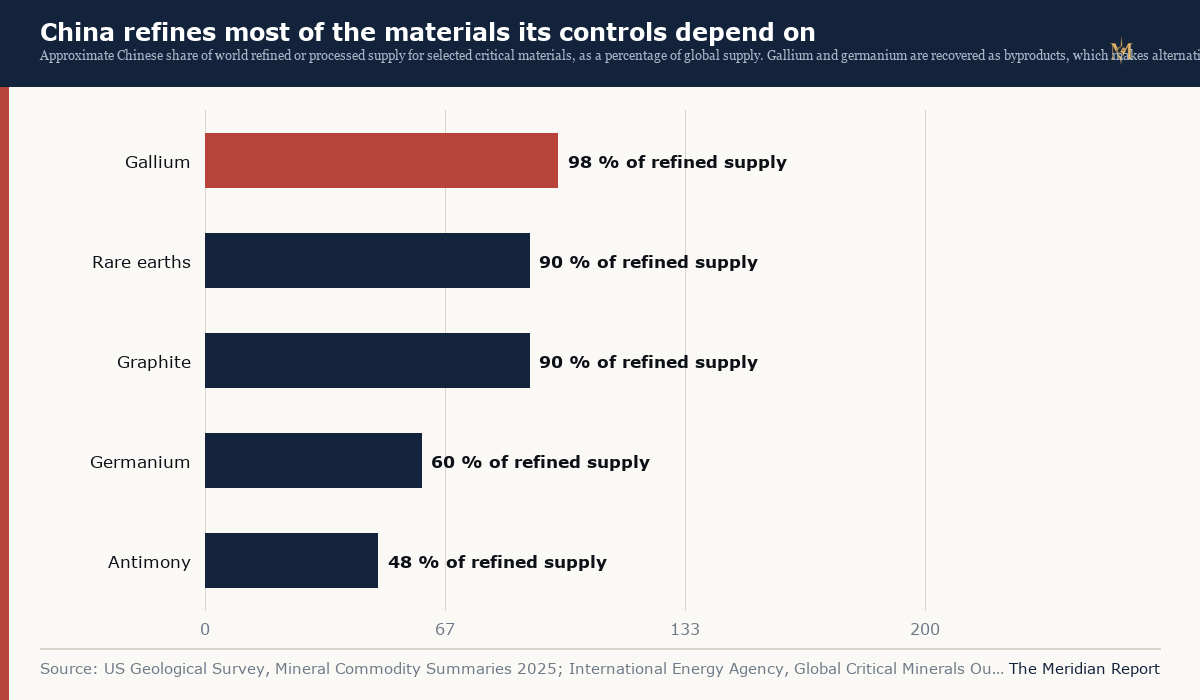
The Chinese export control law took effect in December 2020, and it created a legal basis for controls on dual use items, military items and nuclear items. The law was followed by a series of measures that were targeted at the materials and components that China dominates: gallium and germanium in August 2023, graphite in December 2023, antimony in September 2024, and a ban on exports of gallium, germanium and antimony to the United States in December 2024.
The rare earth measures are the most consequential. In April 2025 China imposed export licensing on seven medium and heavy rare earth elements and on the magnets made from them, which affected the supply of materials used in electric motors, defence systems and electronics. In October 2025 it expanded the controls to five more elements, to the technology used to process them and to foreign products that contain Chinese rare earths above a threshold of 0.1 per cent by value.
That last measure is the mirror image of the foreign direct product rule. It extends Chinese controls to products made outside China that contain a small share of Chinese material, which is the same logic that the United States uses to reach foreign made chips. The threshold is low enough that a wide range of products could be captured, and the measure is a direct response to the American use of the foreign direct product rule.
The Chinese regime has weaknesses. It is less administratively developed than the American one, the licensing process is opaque, and the controls have damaged Chinese exporters as well as foreign buyers. It has one great strength: China is the dominant processor of the materials it controls, and a buyer that cannot source them elsewhere has no alternative.
The minerals are a different kind of leverage
The semiconductor controls target a technology in which the United States and its allies have a lead. The mineral controls target a supply chain in which China has a lead, and the two are not symmetrical.
A semiconductor fab can be built in the United States, Taiwan, Korea or Japan, and the equipment can be made in the Netherlands, Japan and the United States. The lead is technological and it is held by a group of allies. A rare earth separation plant can be built anywhere with the capital and the permitting, and the reason it is not built is that China can undercut it on price and that the customers have optimised for the Chinese supply.
The mineral leverage is therefore a price problem rather than a technology problem. China can restrict the supply of a material that it refines, and the buyer can respond by paying more, by stockpiling, by recycling or by building a refinery. Those responses take years, which is why the mineral controls have an immediate effect and a declining one.
The October 2025 measures added a new dimension, which is the extraterritorial reach. A product made in Germany that contains Chinese rare earths above the threshold is subject to Chinese controls, which means a German manufacturer may need a Chinese licence to export its own product. The measure is a direct challenge to the American-led controls, and it is likely to be tested in the World Trade Organization and in the diplomacy of the next few years.
OFAC is a different instrument with a different logic
The sanctions regime administered by the Office of Foreign Assets Control is often discussed as if it were the same as export controls. It is not.
Export controls regulate the item. Sanctions regulate the person. A company can export a chip to a country that is not subject to sanctions, and it can be prohibited from exporting the same chip to a person on the sanctions list. The sanctions list is not a list of items; it is a list of parties, and the prohibition is on dealing with them rather than on the item.
The most important sanctions instrument is the list of specially designated nationals, which imposes a freeze on their assets and a prohibition on transactions with them. The prohibition extends to entities owned 50 per cent or more by one or more designated parties, which is the rule that the entity list has now copied. The 50 per cent rule is the reason a company has to trace ownership before it can conclude that a customer is not sanctioned.
The sanctions regime has a secondary dimension. The United States can impose sanctions on a non-American company that engages in significant transactions with a sanctioned sector, which is a secondary sanction. The measure is controversial because it extends American law to foreign companies that have no American connection, and it has been used extensively against Russia and Iran.
The overlap with export controls is where the compliance risk is highest. A transaction that involves a sanctioned party and a controlled item requires an OFAC licence and a BIS licence, and the two agencies have different standards and different timelines. A company that obtains one and not the other is in breach, and the penalty can be imposed by both.
Enforcement is the part that makes the regime real
A control that is not enforced is a suggestion. The American enforcement record is the evidence that the regime is real, and it is also the evidence that the regime is uneven.
The Bureau of Industry and Security has an Office of Export Enforcement with agents in field offices and in embassies, and it investigates cases that come from voluntary disclosures, from customs data, from intelligence and from whistleblowers. The cases range from a small company that shipped a controlled item without a licence to a large company that knowingly sold to a restricted party.
The penalties are calculated per violation, and the number of violations can be large. A shipment that is split into a hundred invoices is a hundred violations, and the penalty can exceed the value of the goods. The largest settlements have been in the hundreds of millions of dollars, and they have been imposed on companies that cooperated and on companies that did not.
The Seagate case is the best known. In 2023 the company agreed to pay 300 million dollars to settle allegations that it had sold hard disk drives to Huawei after the entity listing, making it one of the largest administrative penalties in the history of the export control regime. The case established that a company cannot rely on a foreign subsidiary or a distributor to make a sale that the parent cannot make.
Criminal enforcement is separate. The Department of Justice prosecutes wilful violations, and the penalties can include imprisonment. The cases are often brought against individuals as well as companies, and the individual cases are a deterrent that the corporate penalties are not.
The compliance industry and the cost of a licence
Every controlled export requires a compliance process, and the process has become an industry. Companies screen customers against the lists, classify their products, obtain licences, train their staff and audit their distributors. The cost is proportional to the size of the business and to the number of jurisdictions, and it is a fixed cost that falls hardest on the small companies.
The screening is the most visible part. A company has to check its customer, its customer's owners, its customer's address and the end use against the lists, and it has to do so at the time of the transaction. The lists change frequently, and a customer that was clear yesterday may be listed today. The screening software is expensive and it produces false positives, which a compliance team has to resolve.
The licensing is the slowest part. A licence application for a controlled item can take months, and the review can require an end user statement, an import certificate and a visit. The delay is a cost that the exporter bears, and it is a reason why some exporters decline business rather than apply.
The deemed export rule adds another layer. A company that employs a foreign national in the United States may be deemed to export controlled technology to that person's country, and the company has to obtain a licence or a technology control plan. Universities and research laboratories have found this rule particularly difficult, because their staff and students are international and their research is often collaborative.
The cost of compliance is a barrier to entry that favours the incumbents. A large company can absorb the fixed cost and the delay; a small company cannot. The controls therefore have an industrial policy effect that is independent of their stated objective, and the effect is to concentrate the industry in the hands of the companies that can afford the paperwork.
What the controls have achieved
The first question about any control is whether the target changed its behaviour. The evidence on the semiconductor controls is mixed, and it is best read as a set of separate findings rather than a verdict.
The first finding is that the controls slowed the expansion of China's most advanced manufacturing. The most advanced fabs in China have been limited in their access to extreme ultraviolet lithography, and the machines they can buy are restricted to older generations. The result is that China's leading edge capacity is smaller and less advanced than it would have been without the controls, and the gap has widened in the most advanced nodes.
The second finding is that the controls did not stop the development of advanced chips. In 2023 Huawei released a phone with a processor made by SMIC on a 7 nanometre process, which was more advanced than the controls were designed to allow. The chip was produced with deep ultraviolet lithography and multiple patterning, a technique that is more expensive and less efficient than extreme ultraviolet, and it demonstrated that a determined manufacturer can push older equipment further than the export control thresholds assumed.
The third finding is that the controls accelerated China's domestic substitution. The share of Chinese made equipment in Chinese fabs has risen, the domestic memory and logic industries have received large state investments, and the design tools and materials that were once imported are being developed locally. The substitution is uneven and it is expensive, and it is the outcome that the controls were least designed to produce.
The fourth finding is that the controls raised the cost of computing in China. The price of advanced chips rose, the supply of the most advanced artificial intelligence hardware was constrained, and companies that needed the hardware had to queue, pay a premium or use less advanced alternatives. The cost is real and it is a intended effect.
The fifth finding is that the controls changed the geography of the industry. New fabs have been announced in the United States, Japan, Korea, Taiwan, Germany and India, and the subsidies that accompanied them are the largest industrial policy intervention in the sector's history. The new capacity will not replace the existing capacity, and it will reduce the concentration of the supply in Taiwan, which was a stated objective of the policy.
Huawei is the test case
Huawei is the company that the controls were most clearly designed to constrain, and its trajectory is the best evidence of what the controls can and cannot do.
Huawei was added to the entity list in 2019, and the foreign direct product rule was applied to it in 2020. The effect was severe: the company lost access to Google services, to American chips and to the foundries that used American equipment, and its smartphone business collapsed. Its revenue fell, it sold its Honor subsidiary, and its future looked uncertain.
The company did not disappear. It rebuilt its supply chain around Chinese suppliers, it developed its own operating system, and it designed its own processors. The 2023 phone was the public demonstration that the rebuilding had worked, at least for a 7 nanometre chip. The company's revenue recovered, its cloud and automotive businesses grew, and it became the symbol of the limits of the controls.
The lesson is not that the controls failed. Huawei's chips are more expensive and less advanced than the ones it would have bought, and its access to the most advanced manufacturing is still restricted. The lesson is that a company with a large market, a patient state and a strong engineering culture can build a substitute, and that the substitute takes years and costs a great deal.
The second lesson is that the controls are a moving target. Each time a Chinese company demonstrates a capability, the American rules are revised to cover it, and each revision gives the company an incentive to build the next substitute. The dynamic is a race between the control list and the domestic industry, and the outcome depends on which moves faster.
The artificial intelligence question
The most consequential part of the controls is not about smartphones. It is about the computing capacity that trains artificial intelligence, because that capacity is the input to the technology that the American government considers the most strategically important.
The advanced computing controls restrict the export of the most powerful graphics processors and accelerators, the memory that accompanies them and the equipment that makes them. The restrictions have been revised several times, and each revision has tried to capture the performance level that matters for the largest artificial intelligence training runs.
The effect on China's artificial intelligence industry is contested. Chinese companies have stockpiled the chips they could buy, they have designed their own accelerators, and they have used cloud computing outside China to access capacity. The largest training runs are still concentrated in the United States, and the gap in the most advanced hardware is real. The gap in the models is smaller, because the algorithms are public and the researchers are mobile.
The controls have also had an unintended effect on the American companies. Nvidia, which makes the most advanced accelerators, lost a significant share of its Chinese revenue, and it designed a series of reduced performance chips to stay within the rules. The rules were revised to capture those chips, and the cycle repeated. The company's response was to argue that the controls were counterproductive, and its argument had some support in the evidence that the reduced chips were being replaced by domestic alternatives.
The stockpiling and the grey market
A control that restricts a supply creates an incentive to acquire the item before the restriction takes effect. Chinese companies stockpiled chips and equipment in the months before each revision, and the stockpiles have extended the runway for their operations.
The stockpiling is visible in the trade data. Chinese imports of semiconductor equipment rose sharply in the periods before new controls, and the imports of the restricted chips rose before the thresholds were tightened. The pattern is a predictable response to a predictable policy, and it is one reason the controls have a delayed effect.
The grey market is the other response. Controlled items are diverted through third countries, mislabelled, or sold by distributors that do not ask questions. The enforcement cases often involve a small company in a third country that bought the item legitimately and sold it to a restricted party, and the traceability of the transaction is the challenge for the enforcement agency.
The American response has been to require end user statements, to impose due diligence obligations on distributors, and to use the foreign direct product rule to reach the foreign transactions. The response is effective at the margin and it cannot eliminate the grey market, because the incentive to evade is proportional to the value of the item.
The equipment is the real chokepoint
The most important insight in the export control debate is that the chokepoint is not the chip. It is the equipment that makes the chip.
A chip can be designed in China, and it can be manufactured in a Chinese fab, but the fab needs lithography machines, deposition tools, etch tools, ion implanters, metrology equipment and cleaning equipment. Those tools are made by a small number of companies in the Netherlands, Japan, the United States and Korea, and the most advanced of them are made by one company in each category.
The American controls have focused on the equipment because that is where the leverage is. A restriction on the export of extreme ultraviolet lithography to China prevents the construction of a leading edge fab, and no amount of Chinese investment can substitute for a machine that is not for sale. The restriction on the tools is more effective than the restriction on the chips, because the tools are capital goods with a long lead time and the chips are consumer products that can be stockpiled.
The Chinese response has been to build the tools. The domestic equipment industry has grown rapidly, and it has made progress in deposition, etch, cleaning and metrology. It has not made progress in extreme ultraviolet lithography, which requires a supply chain of mirrors, light sources and precision mechanics that took decades to build. The gap in lithography is the most durable part of the controls, and it is the reason the controls have had any effect at all.
The controls are a subsidy to the American industry
There is an argument, made by economists and by the industry, that the controls are a subsidy to the American semiconductor industry and a tax on its allies.
The argument is that a restriction on the export of American technology to China reduces the competition that American companies face, and allows them to charge higher prices in the markets they can serve. The subsidy is implicit, and it is reinforced by the CHIPS Act, which provides direct subsidies for the construction of American fabs.
The counter-argument is that the controls reduce the revenue of American companies, which reduces their ability to invest in research and development, which weakens them against their Chinese competitors in the long run. Nvidia's lost Chinese revenue is the clearest example, and the company has argued that the controls are counterproductive.
The evidence is not sufficient to settle the argument. The American industry has grown, the Chinese industry has grown, and the allies have grown. The distribution of the gains and losses is uneven, and the political economy of the controls is determined by which companies and which countries bear the cost.
The controls have a legitimacy problem
The controls are justified by national security, and they are applied to a technology that has a commercial use and a military one. The legitimacy of the regime depends on the line between the two being credible.
The line is drawn by the performance thresholds, and the thresholds are technical. A chip with a certain computing performance is controlled, and a chip with slightly less is not. The line is a judgment, and it is a judgment that the American government makes without revealing the intelligence that supports it.
The allies have accepted the line because they share the security concern, and they have questioned it because it imposes costs on their companies. The Chinese government has rejected it as an illegal extraterritorial measure, and it has responded with its own controls. The World Trade Organization has not ruled on the semiconductor controls, and a dispute would be difficult because the security exception is broad and the appellate body is not functioning.
The legitimacy problem is not only legal. It is also a problem of consistency. The United States controls the export of advanced chips to China, and it allows the export of less advanced chips, and it has changed the threshold several times. A regime that changes its rules frequently is a regime that companies cannot plan around, and the planning is what makes the compliance work.
The third country problem
The controls assume that an item has a destination, and the destination is a country. The reality is that an item has a route, and the route can pass through several countries before it reaches the end user.
A chip sold to a distributor in Singapore is exported to Singapore, and the distributor sells it to a customer in Malaysia, and the customer sells the product that contains it to a company in China. Each transaction is legal in its own jurisdiction, and the chain moves the item from a permitted destination to a restricted one without a single violation that is easy to detect.
The American response has been to extend the controls to the re-export and to the end user, and to require distributors to know their customers. The response is effective against a careless distributor and ineffective against a determined one, because the determined one can create a new company for each transaction.
The enforcement cases show the pattern. A company in a third country buys a controlled item, certifies that it will not re-export it, and then sells it to a customer who does. The original seller is not liable if it took reasonable steps, and the burden falls on the enforcement agency to trace the item through the chain.
The third country problem is the reason the controls have not stopped the flow of advanced chips to China. The flow is smaller and more expensive, and it has not stopped. The controls have raised the price and the risk, and they have not closed the route.
The talent controls
A less visible part of the regime is the control on people. The 2022 rules restricted the activities of American persons in support of advanced chip development at Chinese facilities, which meant that an American engineer could not work on certain projects in China without a licence. The rule was a departure from the traditional focus on items, and it was controversial because it restricted the movement of people rather than the sale of goods.
The talent controls are difficult to enforce. An engineer can work for a Chinese company from outside China, can consult, can train and can publish. The rule covers the employment relationship and the technical support, and it does not cover the knowledge in the engineer's head. The effect is to raise the cost of recruiting experienced staff and to encourage Chinese companies to develop their own talent, which they have been doing.
The research controls are a related instrument. The American government has restricted collaboration with Chinese institutions in sensitive fields, and it has imposed visa restrictions and funding restrictions. The restrictions have reduced the flow of students and researchers in some fields, and they have been criticised by universities for the chilling effect on open research.
The long run effect is uncertain. A country that restricts the movement of people may slow the diffusion of knowledge, and it may also weaken its own research base by excluding talent. The balance is a judgment, and the judgment has been made in favour of restriction.
The controls and the World Trade Organization
The legal basis for the controls is the national security exception in the General Agreement on Tariffs and Trade, which allows a member to take measures that it considers necessary for the protection of its essential security interests. The exception is broad, and it has been interpreted narrowly by panels in the few cases that have reached them.
A challenge to the semiconductor controls would face three obstacles. The first is that the security exception is self-judging in practice, and a panel is reluctant to second-guess a member's assessment of its security. The second is that export controls are not tariffs or import restrictions, and the agreement's disciplines on export restrictions are weaker. The third is that the dispute settlement system is not functioning, because the appellate body has no members and the alternative arrangement has not been accepted by the United States.
The result is that the controls are unlikely to be struck down by a trade tribunal. The constraint on them is political and diplomatic, not legal. The allies can refuse to cooperate, the target can retaliate, and the domestic industry can lobby against the cost. Those constraints have shaped the policy more than any legal rule.
The Chinese counter-controls and the risk of escalation
The Chinese controls on gallium, germanium, antimony, graphite and rare earths are a response to the American controls, and they have their own logic. China is the dominant processor of those materials, and it can restrict their supply to countries that restrict the supply of chips and equipment to China.
The escalation is tit for tat, and the risk is that it becomes a spiral. Each side can impose a control that the other cannot easily replace, and each side can retaliate. The semiconductor controls target a technology that China cannot yet make at the leading edge, and the mineral controls target materials that the United States and its allies cannot yet process at scale. The two are matched in disruption and not in substitutability.
The de-escalation is difficult because the controls are embedded in domestic politics. In the United States, the controls are supported by both parties and by the national security establishment. In China, the controls are a symbol of sovereignty and a response to what is seen as a siege. A negotiation would require both sides to give up a lever, and neither has an incentive to move first.
The October 2025 Chinese measures added a new escalation, because they extend to foreign products that contain Chinese material. A German company that makes a motor with Chinese rare earths may need a Chinese licence to export it, which gives China a lever over European industry that it did not have before. The European Union has responded with its own critical minerals policy and with a proposal for a stockpile, and it has not imposed equivalent controls.
What would change the picture
Three developments would materially change the assessment in this report.
The first is a technology that reduces the importance of the most advanced nodes. If artificial intelligence training shifts to architectures that do not require the most advanced chips, or if computing moves to optical or quantum methods that do not depend on the same lithography, the chokepoint would move and the controls would lose their target. The developments are speculative and they are the subject of intense research, and none of them is likely to change the picture this decade.
The second is a change in the American policy. The controls have been tightened by each administration since 2018, and they could be loosened if a deal were reached with China or if the costs to American industry became politically unacceptable. A loosening would not restore the pre-2018 trade, because the Chinese industry has changed and the American industry has changed, and it would reduce the rate of escalation.
The third is a change in the Chinese response. China could decide to accept the controls and to specialise in the mature nodes, where the demand is large and the technology is not restricted. That would be a rational strategy, and it would reduce the pressure on the most advanced nodes. It would also leave China dependent on foreign equipment for the mature nodes, which the controls could extend to.
The indicators to watch
The first indicator is the lithography gap. If China can build or buy a machine that can produce chips below 5 nanometres, the controls have failed at their most important objective. If the gap persists, the controls have achieved their most important objective.
The second indicator is the domestic equipment share. If Chinese fabs can source most of their equipment domestically, the controls lose their leverage. If the share stalls, the controls retain it.
The third indicator is the price of advanced computing in China. A rising price indicates that the controls are binding; a falling price indicates that the substitutes are working.
The fourth indicator is the allied alignment. If the Netherlands, Japan, Korea and Taiwan continue to align, the controls are effective. If they diverge, the controls leak.
The fifth indicator is the enforcement record. A rising number of cases and penalties indicates that the regime is being applied; a falling number indicates that it is being neglected.
The comparison with the cold war
The controls are often compared to the cold war export control regime, which coordinated the Western allies through an organisation called CoCom and restricted the export of strategic technology to the Soviet bloc for four decades.
The comparison is instructive and it is imperfect. CoCom was a multilateral arrangement, and the United States led it with the consent of its allies. The current regime is unilateral at its core, with the allies aligning through bilateral pressure. CoCom controlled a broad list of items, and the current regime controls a narrow set of technologies with global reach. CoCom's target was a bloc with a small civilian technology sector, and the current target is the world's largest manufacturing economy.
The cold war regime worked because the technology gap was large and the allies were united. The current regime faces a smaller gap and a more fragmented alliance. It may succeed at slowing the diffusion of the most advanced technology, and it is unlikely to prevent the diffusion of the technology one generation behind, which is where most of the economic value is.
The cost to the sender
The debate about export controls usually focuses on the target. The cost to the sender is less discussed and it is substantial.
The first cost is revenue. American and allied companies lost sales to China, and the loss is permanent for the products that were banned because the Chinese buyers found substitutes or built their own. The revenue was a source of research funding, and the research is the foundation of the next generation of the technology.
The second cost is credibility. A company that sells a product and then discovers that the rules have changed has a customer that will not trust it. The semiconductor industry sells on long term relationships and roadmaps, and a roadmap that can be invalidated by a regulatory change is a roadmap that customers discount.
The third cost is alliance management. The controls require the Netherlands, Japan, Korea and Taiwan to impose restrictions that cost their companies money. The United States has to compensate them with security guarantees, subsidies and diplomatic attention, and the compensation is not free.
The fourth cost is the administrative burden on the sender's own government. The licensing system requires officials, intelligence, enforcement agents and coordination with allies, and the system has grown faster than the resources devoted to it. A control that cannot be administered is a control that is not enforced, and the gap between the list and the enforcement is where the leaks are.
The benefits are also real. The controls have slowed China's access to the most advanced technology, they have protected the allied lead in the most sensitive areas, and they have given the United States a lever in the broader competition. The question is whether the benefits exceed the costs, and the answer depends on the time horizon and on the value placed on the delay.
The cost to the target
The cost to China is easier to see. The most advanced chips are more expensive and less available, the leading edge fabs are constrained, and the artificial intelligence industry has had to work around the restrictions.
The cost is not only economic. The controls have forced China to invest in domestic capacity that is less efficient, which is a drag on productivity. They have also created a political narrative of siege, which strengthens the case for state investment and for self-reliance.
The offsetting gains are also real. The domestic industry has grown, the equipment makers have a captive market, and the state has a rationale for directing capital to the sector. The controls have accelerated a development that would have happened anyway, and they have made it more expensive and more urgent.
The net effect on China's long run growth is uncertain. A country that is forced to build its own supply chain pays more and learns faster, and the learning can be valuable. A country that is cut off from the frontier pays more and falls behind, and the falling behind can be permanent. The evidence from the last five years suggests that China is paying more and learning faster, which is not the same as catching up.
The mature node problem the controls did not solve
The controls focus on the most advanced chips, and they have left the mature nodes largely alone. That is where the next trade conflict is forming.
A mature node is a manufacturing process of 28 nanometres or larger, and it is used for the chips that go into cars, industrial equipment, appliances, power supplies and medical devices. The market is large, the technology is well understood, and the demand is stable. China has been building capacity in mature nodes at a rate that has alarmed the American and European industries, because the capacity is subsidised and the output is sold at prices that the incumbents cannot match.
The American response was a trade investigation rather than an export control. In December 2024 the Office of the United States Trade Representative opened an investigation under Section 301 into Chinese policies supporting the mature node semiconductor industry, which is the legal route to tariffs. The investigation was a recognition that export controls are the wrong instrument for a technology that China can already make, and that the competitive threat is price rather than capability.
The mature node problem shows the limit of the control strategy. A control can restrict a technology that the target does not have. It cannot restrict a technology that the target has, and it cannot prevent the target from using its cost advantage to take market share. For the mature nodes, the policy instrument is a tariff or a subsidy, not a licence.
The European Union has a similar concern and a weaker instrument. Its Chips Act subsidises capacity in Europe, and its economic security strategy has proposed a review of outbound investment and of the risks in mature node supply chains. The member states have not agreed on tariffs, and the European industry is divided between the companies that buy Chinese chips and the companies that compete with them.
Europe's controls are national, and that is the problem
The European Union does not have a single export control regime. It has a regulation that sets common rules for dual use items, and it leaves the licensing decisions to the member states. A company that wants to export a controlled item applies to the authority of the member state where it is established, and the authority decides under national law and national policy.
The result is a patchwork. The Netherlands has restricted the export of advanced lithography equipment, Germany has restricted some machine tools and encryption items, and other member states have different lists and different practices. A company that can choose where to establish itself can choose the authority that is most sympathetic, which is a familiar problem in a union without a common enforcement body.
The European Commission has proposed a more coordinated approach, including a common risk assessment and a mechanism for consulting on licences that affect several member states. The proposal has been slow because export control is a sensitive national competence and because the member states do not agree on the balance between security and trade.
The patchwork matters for the American controls because the United States needs the European Union to align. A Dutch restriction on lithography is effective only if the machines are not shipped from another member state, and the single market makes that difficult to police. The American response has been to deal with the Netherlands directly, which is efficient and which undermines the European approach.
How a licence decision is actually made
A licence application arrives at the Bureau of Industry and Security and is assigned to a licensing officer, who checks that the application is complete and that the item is classified correctly. The officer then consults the other agencies that have an interest: the Department of Defense for military applications, the Department of State for foreign policy, the Department of Energy for nuclear items and the intelligence community for the end user.
The consultation is where the decision is really made. Each agency has a different mandate and a different risk tolerance, and the licensing officer has to reconcile them. A case that the Commerce Department regards as commercially routine may be a case that the Defense Department regards as a military capability transfer, and the disagreement is resolved by escalation rather than by a formula.
The end user statement is the key document. It is signed by the customer and it identifies the end use, the end user and the commitment not to divert the item. A statement from a company with a good record is accepted; a statement from a company in a country with a weak enforcement record is scrutinised. A false statement is a violation, and the penalty falls on the customer as well as the exporter.
The timelines vary. A routine application for a low risk destination can be decided in weeks. A complex application for a high risk destination can take months, and it can be returned with a request for more information that restarts the clock. The delay is a cost that the exporter bears, and it is one reason why some companies decline business rather than apply.
The system has an appeal route. An applicant can request an advisory opinion, can ask for reconsideration, and can in principle take the case to court. The routes are slow and rarely used, because a company that litigates against its own government is a company that has decided the relationship is already lost.
The licensing queue is therefore an instrument of policy as well as an administrative process. A government that wants to slow a trade without banning it can do so by asking for more information, and a government that wants to permit a trade can do so by expediting the application. The discretion is the point, and it is the reason the regime is described as a licensing system rather than a prohibition.
The policy has never had a theory of victory
The controls have been tightened in five rounds since 2018, and each round has been justified by the same logic: the technology is strategic, the adversary is a threat, and the delay is worth the cost. What the policy has never specified is what success looks like, and the absence of a definition is the reason the debate is so difficult.
If success means preventing China from making advanced chips, the controls have failed, because China makes advanced chips. If success means delaying China's access to the most advanced nodes by several years, the controls have probably succeeded, and the size of the delay is unknown. If success means preserving an American technological lead, the controls are one instrument among many, and the lead depends on investment, education and immigration as much as on export rules.
The absence of a theory of victory has a practical consequence. It makes the policy impossible to evaluate, which makes it impossible to correct. A programme with a target can be judged against the target and adjusted. A programme without one can only be judged by its direction, and the direction has been more restrictions for eight years.
That is not an argument for abandoning the controls. It is an argument for stating what they are for, so that the next revision can be judged against the objective rather than against the precedent. A policy that is always tightening is a policy that cannot stop, and a policy that cannot stop will eventually be tested by an ally, a court or a market that it cannot control.
What the numbers do not establish
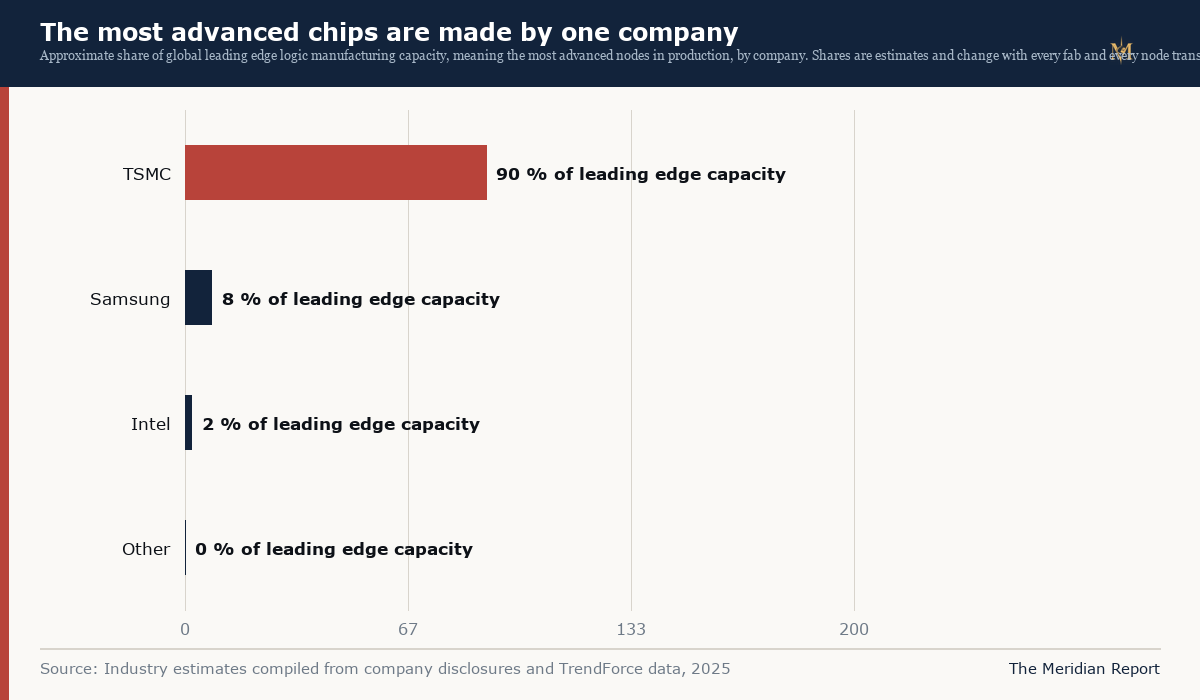
The capacity figures in this report are estimates from industry analysts and company disclosures. They describe nominal capacity and not output, and they change with every expansion. A share of 90 per cent of leading edge capacity is a description of a market position, not a measurement of a plant.
The revenue losses are company disclosures and analyst estimates, and they are not audited. A company that reports a loss of Chinese revenue may be reporting a loss that it would have suffered anyway, and a company that does not report a loss may be selling through a third country.
The penalty figures are settlements, and a settlement is not a finding of liability. The companies that settle often do so to avoid the cost of litigation, and the amount reflects the strength of the evidence as well as the conduct.
The claim that the controls have slowed China's development is a counterfactual, and the counterfactual cannot be observed. The evidence is consistent with the claim, and it is also consistent with the claim that China would have developed more slowly anyway, because the technology is hard and the capital is scarce. The controls may have made a difference at the margin, and the size of the margin is unknown.
What the record establishes
The export control system is a licensing regime with global reach, and it has changed the behaviour of companies in every country that participates in the semiconductor supply chain. It has slowed China's access to the most advanced chips and equipment, and it has accelerated China's investment in domestic substitutes.
It has not stopped the development of advanced chips in China, and it is unlikely to do so. The controls have raised the cost and the time, and they have not closed the route. The most durable part of the regime is the equipment, and the most durable gap is lithography, because the machine is the product of a supply chain that cannot be replicated quickly.
The regime is now matched by a Chinese regime that controls the materials China dominates, and the two are in an escalation that neither side can easily stop. The next phase is likely to be a contest over the extraterritorial reach of the controls, with both sides claiming the right to regulate products made outside their territory.
The allied dimension is the part that will decide the outcome. The controls work only if the Netherlands, Japan, Korea and Taiwan continue to align, and the alignment depends on American leadership, on compensation and on a shared assessment of the threat. A regime that treats its allies as instruments will lose them, and a regime that loses them will not work.
The controls are therefore best understood as a delay rather than a wall. They buy time for the United States and its allies to build capacity, to develop the next generation of technology and to negotiate from a position of strength. A delay is a legitimate objective, and it is not the same as a victory. The policy has never been clear about which one it is pursuing, and the ambiguity is the source of both its flexibility and its incoherence.
Sources
- US Bureau of Industry and Security, Export Administration Regulations, 15 CFR Parts 730 to 774.
- US Bureau of Industry and Security, Entity List, Supplement No. 4 to Part 744.
- US Bureau of Industry and Security, advanced computing and semiconductor manufacturing export controls, October 2022 and updates.
- US Bureau of Industry and Security, Affiliates Rule, September 2025.
- US Department of the Treasury, Office of Foreign Assets Control, sanctions programs and guidance.
- Ministry of Commerce of the People's Republic of China, export control announcements, 2023 to 2025.
- Ministry of Commerce and Ministry of Foreign Affairs of China, rare earth export control measures, October 2025.
- Netherlands Ministry of Foreign Affairs, export restrictions on advanced semiconductor manufacturing equipment, 2023.
- Japan Ministry of Economy, Trade and Industry, export control measures on semiconductor manufacturing equipment, 2023.
- International Energy Agency, Global Critical Minerals Outlook 2024.
- US Geological Survey, Mineral Commodity Summaries, graphite, gallium, germanium and rare earths, 2025.