
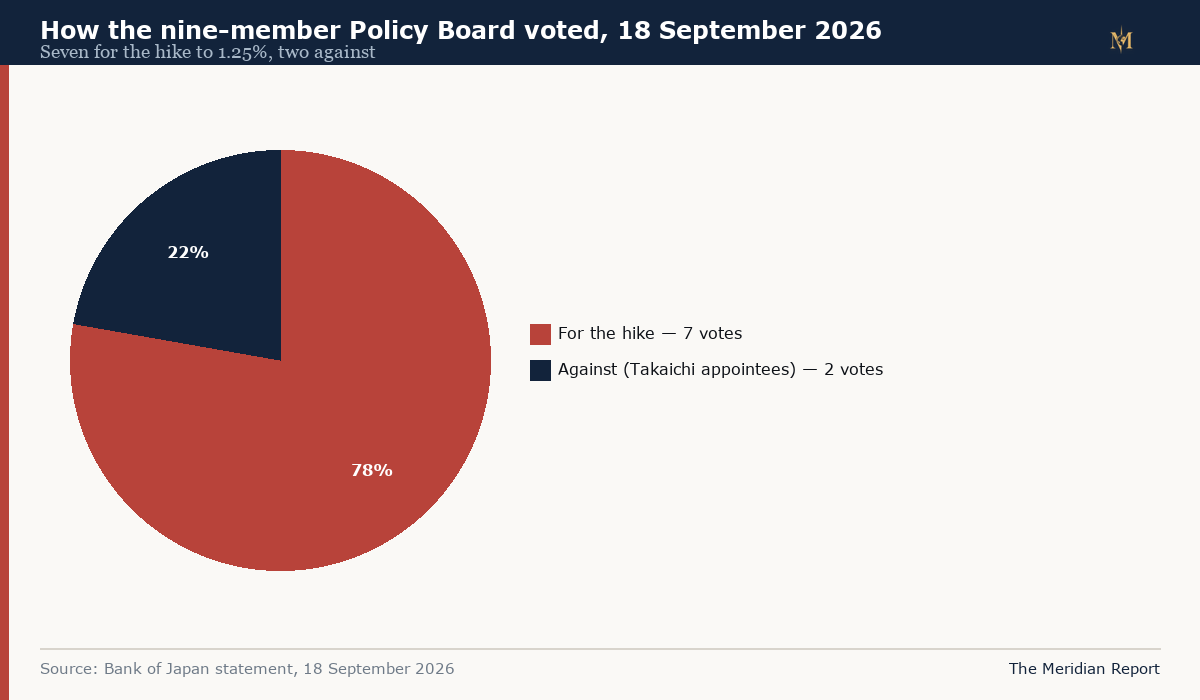
The Bank of Japan raised its short-term policy rate from 1.0% to 1.25% on 18 September 2026, the highest level for the rate since the mid-1990s, completing a week in which the world's two most systemically important financial debates — how fast the United States can finish fighting inflation, and how far Japan can travel from decades of zero rates — moved in the same direction within seventy-two hours. The decision, announced at around 13:00 Tokyo time (04:00 GMT) on Friday at the end of a two-day meeting in Tokyo, was taken by a 7-2 vote of the nine-member Policy Board. The new guideline takes effect on 24 September 2026.
The vote matters as much as the number. The two dissenters, Toichiro Asada and Ayano Sato, joined the board in 2026 on the nomination of Prime Minister Sanae Takaichi's government — appointees widely described in February, when their nominations were announced, as advocates of economic stimulus. Their first public split from the majority is the clearest evidence yet that the political coalition behind the Bank's normalisation is thinning at exactly the moment the Bank is signalling more hikes to come.
The market verdict was immediate and, to most observers, unsettling: the yen barely moved. It had been falling before the decision — around 156 to the dollar in Asian trading on the day — and stayed weak after it. The explanation is arithmetic rather than psychology, and this report traces it in full: two days earlier, on 16 September, the Federal Reserve under new chair Kevin Warsh raised its own target range by the same 25 basis points, to 3.75%-4.00%. Two central banks moved in the same direction by the same amount. The distance between them — the number that actually governs the flow of money between Tokyo and the world — did not change.
What exactly happened, and when
The Bank of Japan's statement, published on the Bank's own website at the conclusion of the meeting, sets out the decision in unusually concrete terms:
- The decision: the Policy Board voted, by a 7-2 majority, to "encourage the uncollateralized overnight call rate to remain at around 1.25 percent," up from around 1.0 percent. The call rate is the interest banks charge each other for overnight uncollateralized loans, and it is the rate the BOJ actually targets.
- The effective date: 24 September 2026. Between the announcement and that date, the previous 1.0% guideline remains in operation.
- The companion rates: the interest rate on the complementary deposit facility — what banks earn on excess reserves parked at the BOJ — becomes 1.25%, and the basic loan rate rises to 1.5%.
- The meeting itself: per the statement's own record, the board met from 14:00 to 15:59 on Thursday 17 September and from 9:00 to 11:47 on Friday 18 September, with Governor Kazuo Ueda's post-decision press conference following the announcement.
- The votes: for the hike — UEDA Kazuo, HIMINO Ryozo, UCHIDA Shinichi, TAKATA Hajime, TAMURA Naoki, KOEDA Junko, and MASU Kazuyuki. Against — ASADA Toichiro and SATO Ayano.
The assembly of those facts from the primary document matters because the deadline-driven summaries that reach most readers compress them away. The 25-basis-point size was expected by markets — pricing in the days before the meeting put the probability of a hike above 80% — but the identity of the dissenters was not, and neither was the full sentence the Bank used about its future path: given that underlying inflation has been approaching 2% and financial conditions remain accommodative, the Bank "will continue to raise the policy interest rate and adjust the degree of monetary accommodation." That is explicit, standing guidance for further increases, not the conditional language central banks usually hide behind.
The two dissents, and the government behind them
Central bank dissents are usually academic. These are not, because of who cast them.
In February 2026, the Takaichi government nominated Asada Toichiro, a Chuo University professor known for advocating large-scale fiscal-monetary stimulus, and Ayano Sato, an Aoyama Gakuin University professor, to the BOJ's nine-member Policy Board — replacing two of the board's most dovish members. Reporting at the time, including Reuters' characterisation that the prime minister had "got her doves in a row," treated the appointments as a signal that the government wanted the Bank to stay loose while it pursued expansionary fiscal policy. Both were approved by the lower house of the Diet in March 2026.
On 18 September, both voted against a hike of only 25 basis points, at a moment when headline inflation had reached its highest level this year. Their stated reasons, recorded in the BOJ statement, are precise:
- Asada dissented "considering that, with the rate of increase in the CPI (all items less fresh food) being below 2 percent recently, it could not necessarily be said that the economic situation was strong," and that it was therefore desirable to maintain the existing guideline.
- Sato dissented "considering that current economic and price developments did not appear to have substantially accelerated compared to before," making a hike at this time inappropriate.
Two of the government's own appointees voted against a modest hike while citing inflation below target. Two other board members, Takata and Tamura, went further in the dissent recorded against the outlook section itself: both opposed the statement's price outlook on the grounds that underlying CPI inflation has already reached the 2% target — a hawkish dissent, wanting the Bank to say out loud that the target is met. The board is not splitting into pro- and anti-tightening camps so much as splitting over how fast to move and how confident to sound. But the direction of travel is unmistakable: the margin for future hikes has narrowed from unanimity to 7-2 in a single meeting, and the two noes are the people the government put there to say no.
Why the Bank is doing this: the inflation arithmetic
The BOJ's mandate is the "sustainable and stable achievement of the price stability target of 2 percent." The dilemma of 2026 is that Japan's inflation is both too low and too high at the same time, depending on which measure you read and which horizon you use.
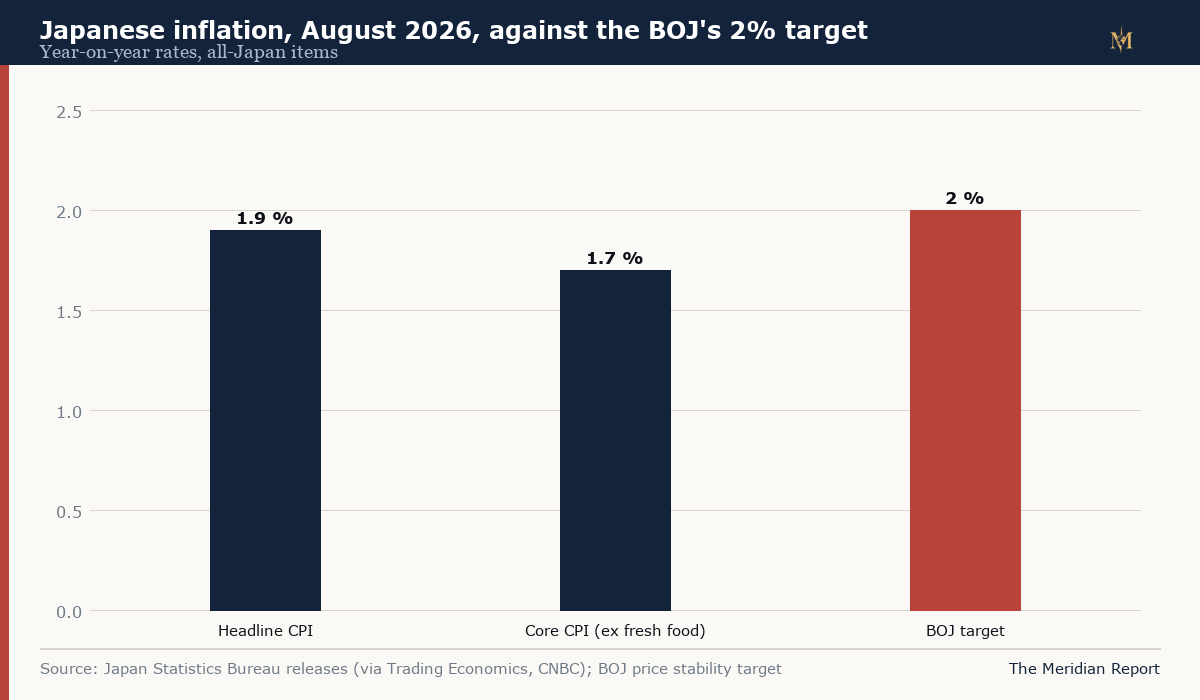
The most recent all-Japan data, for August 2026 released by the Statistics Bureau, put headline consumer price inflation at 1.9% year on year — the highest this year — and core CPI, the measure excluding fresh food that the BOJ cites most often, at 1.7%. Both are below the 2% target. That is the case the two dissenters leaned on.
The Bank's case rests on everything behind those headline numbers. Its statement describes "upward pressure on prices in business-to-business transactions" spilling into consumer prices, wage increases being passed into selling prices, and medium- to long-term inflation expectations that "have continued to rise." It judges underlying CPI inflation to be "approaching 2 percent" — and projects, in the outlook section, that headline CPI will accelerate "to a level clearly above 2 percent from the second half of fiscal 2026" as the rise in crude oil prices since early spring, the increase in semiconductor prices from global AI demand, and the recent depreciation of the yen feed through into durable-goods prices.
Three imported pressures drive the Bank's urgency, and none of them is domestic:
- Oil. Crude prices have risen since early spring on Middle East supply risk. Japan imports nearly all of its energy, so oil moves straight into electricity, petrol and plastics — and through them into every shipped good.
- The weak yen. Import prices in yen terms rise when the currency falls. The statement explicitly cites "the recent depreciation of the yen" among the forces pushing prices up. This is the feedback loop that makes the BOJ's task self-referential: not hiking keeps rates low, low rates keep the yen weak, a weak yen pushes inflation up, and higher inflation then demands the hike the Bank deferred.
- AI-driven semiconductor demand. The Bank cites the expansion in global AI-related demand raising semiconductor and other input prices — for a country whose industrial heartland supplies the chip materials and equipment underneath that boom, this is a cost-push channel no other central bank faces at the same intensity.
The historical lesson the Bank is applying is its own 1970s record and, more recently, the mistake of assuming imported inflation would wash out. Once wage-setting absorbs price shocks — and the statement's phrase "moves to pass on wage increases to selling prices have been continuing" says the Bank believes that has happened — inflation stops falling back on its own. Hiking while inflation is still at 1.7-1.9% is cheaper than hiking after it has re-anchored at 3%.
How the decision was built: the system inside the meeting
A BOJ decision does not appear on the Friday. The September meeting ran on rails laid months earlier, and the rails explain the outcome better than any single data release.
The Bank operates through scheduled Monetary Policy Meetings, eight a year, each producing a statement that fixes the intermeeting guideline for the call rate. The mechanism that turns a "guideline" into reality is the corridor the Bank charges and pays around the target: banks holding surplus reserves at the BOJ now receive 1.25% on them (the complementary deposit facility), and banks needing funds can borrow at 1.5% (the basic loan rate). Because no bank should lend overnight for less than it earns at the BOJ, or borrow from the market when the BOJ lends more dearly, the overnight rate gravitates into the corridor around 1.25%. This is why the statement's technical changes to facility rates are not footnotes — they are the machinery that makes the target bind.
Three things since the July meeting pushed the board toward action:
- The July meeting itself held at 1.0%, with Governor Ueda then telling reporters on 2 September that "a rate hike will be discussed thoroughly in every meeting, including the next one" — language that, from a central bank that had spent a decade avoiding forward commitments, functioned as an appointment.
- Tokyo-area inflation data released at the end of August showed core Tokyo CPI at 1.8% with the more tightly watched measure excluding food and fuel at 2.0% — the leading indicator for the national figures the Bank would see before October.
- The government's own stance shifted from resistance to tolerance. The Takaichi government's fiscal programme — the statement credits "the government's various measures" as supporting demand — is itself inflationary, and a government spending freely loses the standing to demand the Bank suppress prices forever. The dissents show the tolerance is wearing, but it held.
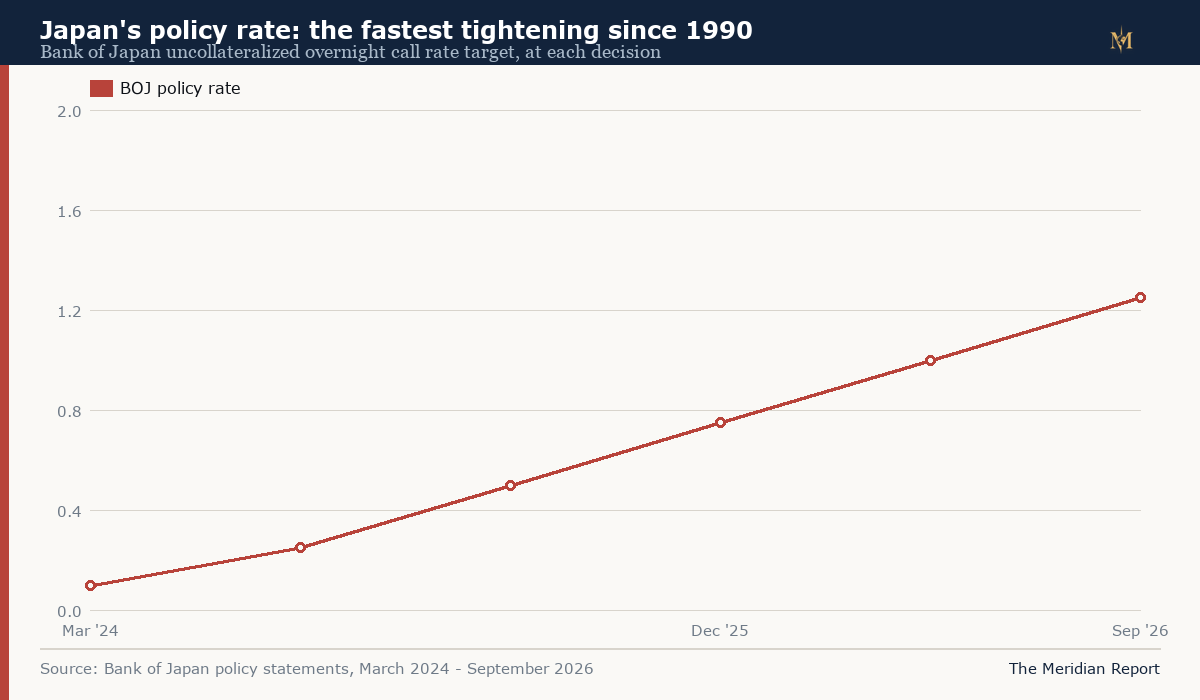
The 30-year context matters here, and only as much as it needs to: the last time this rate stood at 1.25% was the mid-1990s, before Japan's asset-bubble deflation, two decades of near-zero rates and the world's largest experiment in monetary easing. Every step since March 2024 — ending negative rates, abandoning yield-curve control, and lifting the call rate in six steps from 0.1% to 1.25% — is a first for the people taking it. That inexperience is not rhetorical colour; it is why the Bank moves in 25-basis-point steps with meeting-by-meeting review, and why the vote margin is watched as closely as the rate itself.
The 72 hours that frame this decision: the Fed did the same thing first
The BOJ hike landed into a market already repriced by the Federal Reserve. On 16 September 2026, the FOMC voted 12-0 to raise the federal funds target range by 25 basis points to 3.75%-4.00%, its first increase since 2023, under new chair Kevin Warsh. The Fed's summary of economic projections released with the decision showed the policy rate in the 4.00%-4.25% range by the end of 2026 — at least one more hike this year. American equities fell hard on the news; the Dow dropped more than 600 points as Warsh's press conference made clear the priority is a "timelier" return of inflation to 2%, even at the cost of growth.
The synchronisation matters for three concrete reasons:
First, it removes the "Japan alone" excuse for yen weakness. For most of 2025 and 2026, the carry trade's defence was that Japanese rates were irrelevant because American rates were falling or static. Both legs of that defence are now gone. The US is tightening again, and Japan is tightening on its own initiative, in the same week, citing the same problem: inflation that will not finish.
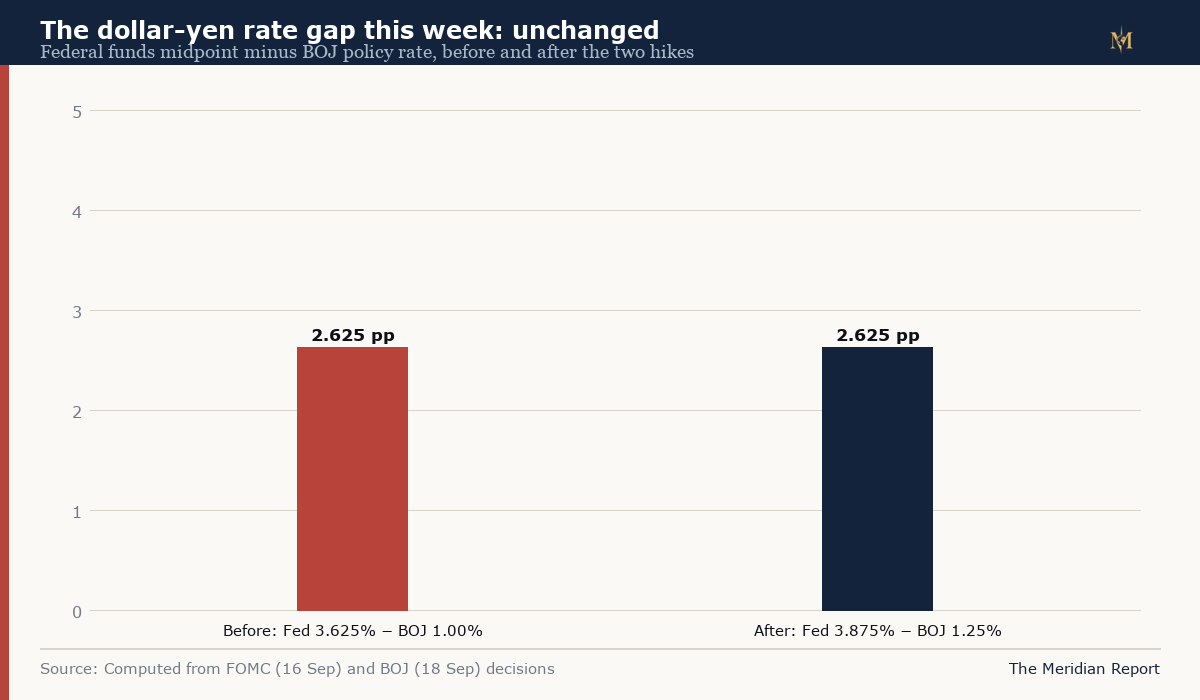
Second, it caps the dollar-yen rate gap rather than narrowing it — for now. The federal funds midpoint stands at 3.875%; the BOJ's call rate at 1.25%. The gap is 2.625 percentage points, exactly what it was before both meetings, when the numbers were 3.625% and 1.00%. A carry trader borrowing yen to hold dollars earns the same spread this Friday as last Friday. That is the whole explanation for the yen's non-reaction, and the chart below is the picture of it.
Third, it sets up the real test in the next two quarters. If the Fed's projections are right and the BOJ's guidance is real, the gap narrows from both ends for the first time in the cycle: the BOJ's statement promises more hikes, and Fed projections put the US at 4.00-4.25% while markets must price whether Warsh goes beyond. Every 25 basis points of BOJ tightening that is not matched in Washington shrinks the carry that finances trillions of dollars of positions, from Mexican and Brazilian bonds to Nasdaq futures to, as reporting on Bitcoin's sensitivity to the BOJ cycle has noted, leveraged crypto positions.
Who is affected, and through what channel
Japanese households and firms. The call rate is not what families pay; it is what banks pay. But bank funding costs set loan pricing, with a lag of weeks to months. Variable-rate mortgages — the dominant mortgage product in Japan, repricing twice a year against short-term rates — rise first. Firms refinancing working-capital lines pay more. Savers, who have accepted near-zero deposit returns for a generation, see better terms with a similar lag, and the regional banks whose margins were crushed by zero rates get breathing room. The BOJ's own statement notes financial conditions "have been accommodative" and real interest rates "remained at low levels" — its way of saying that even at 1.25%, policy is still expansionary in real terms while inflation runs near 2%.
The government's balance sheet. Japan's debt is roughly twice its GDP. Each point of short-rate increase flows into the cost of rolling that debt over years, not overnight — the average maturity of Japanese government bonds is long — but the direction is one-way, and a Finance Ministry watching debt-service costs rise has its own view about how fast the Bank should go. This tension between the ministry and the Bank is structural, and the dissents give it a louder voice inside the Bank itself.
Global investors in the carry trade. The mechanism, concretely: a fund borrows yen at, say, 1.5%, converts to dollars, and buys US assets yielding 4.5%. The 3-point spread minus transaction costs is the trade. Japanese rates rising by 25 basis points raise the borrowing cost by the same amount — a one-sixth cut in that spread, repeated with every hike. Positions rarely blow up from one hike; they bleed, then unwind in size when volatility strikes, because leveraged investors must post collateral and sell what they can. August 2024 demonstrated the velocity: a BOJ hike and a weak-US-jobs print together forced a violent carry unwind, and the Nikkei's worst session since 1987 dragged equity indices from Frankfurt to New York with it. Japanese two-year yields reaching 31-year highs in the run-up to this meeting, and the 10-year Japanese government bond yield trading near 3% — levels last seen in the 1990s — are the same force compounding quietly.
Asian and emerging-market borrowers. Japanese banks are the world's largest cross-border lenders among the major economies' banks, and much of that book funds in yen. As yen funding becomes more expensive, the marginal borrower in Southeast Asia, India or Latin America pays more or goes elsewhere. The channel is gradual, denominated in basis points, and real.
Anyone exposed to semiconductors. The BOJ statement's repeated citation of AI-related demand is not decorative. Semiconductor materials and equipment are among Japan's great industrial strengths, and the Bank explicitly ties the AI build-out to Japanese producer prices and export volumes. Tighter Japanese money at the centre of the AI supply chain is a new variable for an industry already navigating export controls and cyclical risk.
The constraints: why the Bank can move, but only so fast
The debt constraint. At 1.25% the BOJ pays interest on commercial banks' roughly five-hundred-trillion-yen of reserves at the Bank, and the government's interest bill rises with the market rates that follow. Normalisation is affordable in normal years; the question is the terminal rate, and every hike raises the price of the next one.
The political constraint. The Takaichi government's programme is fiscal expansion, and its appointees now vote their preferences openly. A Bank that tightens faster than the government's comfort can expect more dissents, and — the rare but real tail risk — explicit political pressure on the Bank of Japan Act's independence. The 7-2 vote is the early warning system for exactly this.
The growth constraint. The statement concedes "some weakness has been seen in part, partly due to the impact of the situation in the Middle East," housing investment is "on a declining trend," and household sentiment shows weakness despite resilient consumption. The Bank is hiking into an economy that is growing moderately but decelerating, which is why it insists financial conditions remain accommodative and why it moves in the smallest conventional step.
The credibility constraint — in both directions. Too slow, and the weak-yen/oil loop pushes inflation above target with expectations following, forcing a later, harsher cycle. Too fast, and the Bank risks the 2024 scenario again: a carry-unwind shock that punished Japanese equities and rippled outward, plus a housing market already soft. The 25-basis-point cadence with meeting-by-meeting review is not timidity; it is the only path that threads both failures.
What the evidence says — and what would prove it wrong
The Bank's thesis is that inflation is becoming domestic and durable: wages passed into prices, expectations rising, underlying inflation approaching 2%. The supporting evidence in the primary document is specific — B2B price pressure spilling over, wage pass-through continuing, medium- to long-term expectations rising — and the Tokyo August data (core 1.8%, ex-food-and-fuel 2.0%) independently supports the trajectory toward "clearly above 2 percent" in the second half of fiscal 2026 that the statement projects.
The countervailing evidence is the national data itself: 1.9% headline and 1.7% core remain below target, housing is declining, and household sentiment is weak. If the common explanation — a Bank confidently normalising — were wrong, we would expect to see: Tokyo CPI falling rather than edging up in the autumn releases; wage round data softening; the yen stabilising without further hikes (removing the import-price impulse); or the government publicly overriding the Bank. This report will track those four markers, because each is a falsifiable test of the thesis on which the 1.25% decision rests.
What the evidence does not yet establish is the terminal rate. Market commentary before the meeting ranged from a peak near 1.75% to above 2%; the Bank, deliberately, says nothing about a destination, only that it "will continue to raise the policy interest rate" while examining the Middle East, AI demand and exchange rates. Anyone quoting a specific BOJ endpoint this week is reading tea leaves; the honest statement is that the direction is committed and the speed is data-dependent.
What happens next
Confirmed by the Bank's own documents: the new 1.25% guideline and corridor take effect on 24 September 2026; the next Monetary Policy Meeting ends on 28 October 2026; the statement commits the Bank to continuing to raise rates in response to developments, and Governor Ueda's press conference — held after this report's publication deadline — will be parsed for the phrase-level nuance the market now demands of him.
Announced elsewhere: the Fed's projections imply at least one further US hike this year; Japan's national September CPI arrives in mid-October; the Takaichi government's autumn fiscal package, which the BOJ's statement credits as demand support, lands against a Bank that is now openly counting its inflationary effect.
Possible scenarios, clearly labelled as such: a December hike to 1.50% is the market's modal path if October's Tokyo data confirms the statement's projections, with the dissent margin the number to watch — a 6-3 or worse vote changes the political calculus even if the rate rises. A pause at 1.25% becomes the base case if Middle East oil spikes demand caution and the growth cost of the existing hikes shows up in Q3 GDP. A renewed yen slide past the levels that historically trigger intervention (the Ministry of Finance has intervened before, and its tolerance band is a live variable) would accelerate rather than delay hikes, because it feeds the import-price loop. None of these is a prediction; they are the three branches the evidence makes live.
What remains genuinely uncertain: how much of the AI-demand impulse is transitory cost-push versus durable reflation; whether the two dissents harden into a blocking faction or fade as the government's own inflation math bites; and how the carry trade absorbs the first BOJ cycle that tightens while the Fed tightens — a configuration with no precedent in the instrument's modern history.
The cycle so far, on the record
Because normalisation is a sequence and not an event, the checkable record matters. Each of these dates and levels comes from the Bank of Japan's own policy statements:
| Date | Policy rate set | What the step marked | |---|---|---| | March 2024 | ~0.1% | Negative rates ended; first hike in 17 years; yield-curve control abandoned | | July 2024 | ~0.25% | The hike that preceded the August 2024 carry-unwind turbulence | | January 2025 | ~0.5% | First half-point-equivalent move of the cycle | | December 2025 | ~0.75% | Highest since 1995 at the time; came with wage-growth evidence | | June 2026 | ~1.0% | Two digits of domestic wage-price momentum acknowledged | | 18 September 2026 | ~1.25% | Highest in roughly 31 years; first dissents from the Takaichi appointees |
The average gap between hikes in this cycle has been about four months. If that cadence held, the next step would arrive around January 2027 — but the Bank has deliberately declined to say, and the October meeting is the earlier decision point.
How to track this story from here
For readers who want to follow the mechanism rather than the headlines, five released-on-a-schedule items carry the real information:
- Governor Ueda's press-conference transcript, published by the BOJ after 18 September's conference — the sentence-level language on the pace of future hikes is the closest thing the Bank gives to a roadmap.
- Tokyo CPI, released in the final week of each month — the leading indicator for national inflation, watched by the Bank itself. October's print lands in late October, just after the BOJ meeting.
- National CPI, released around the 19th-20th of each month by the Statistics Bureau — September data in mid-October tests the statement's projection that inflation accelerates in the second half of fiscal 2026.
- The 28 October 2026 meeting statement — specifically the vote. If Asada and Sato dissent again, the government-Bank friction is structural; if they join the majority, the September split was a negotiation, not a rupture.
- The dollar-yen rate and the Ministry of Finance's behaviour — Japanese authorities have intervened in currency markets in past cycles when yen weakness fed import prices. Intervention headlines change the BOJ's calculus in the direction of more tightening, since a weak yen is the inflation channel the Bank cannot otherwise control.
The longer arc
Every quarter-point from here redraws the price of money that the post-1997 world assumed was permanent. The yen at these levels is a subsidy from Japanese savers to global leveraged investors; Japanese yields near 3% at the ten-year are a bid being withdrawn, incrementally, from every asset priced off the margin of cheap funding. The BOJ is not merely setting a rate; it is running the controlled demolition of the last zero-rate regime on earth, at 25 basis points per meeting, while its government holds its coat and mutters. This week the demolition reached 1.25%, the dissenters spoke, and the markets shrugged — the calm is real, but it is the calm of a gap that has not yet narrowed. The narrowing is scheduled.
Correction and update policy: this report is based on documents and data available as of 18:30 UTC, 18 September 2026. When a material development occurs — Ueda's press-conference language, Ministry of Finance intervention, new CPI prints — the article will be updated with a visible timestamp. Readers who spot an error are invited to write to the address on our contact page.